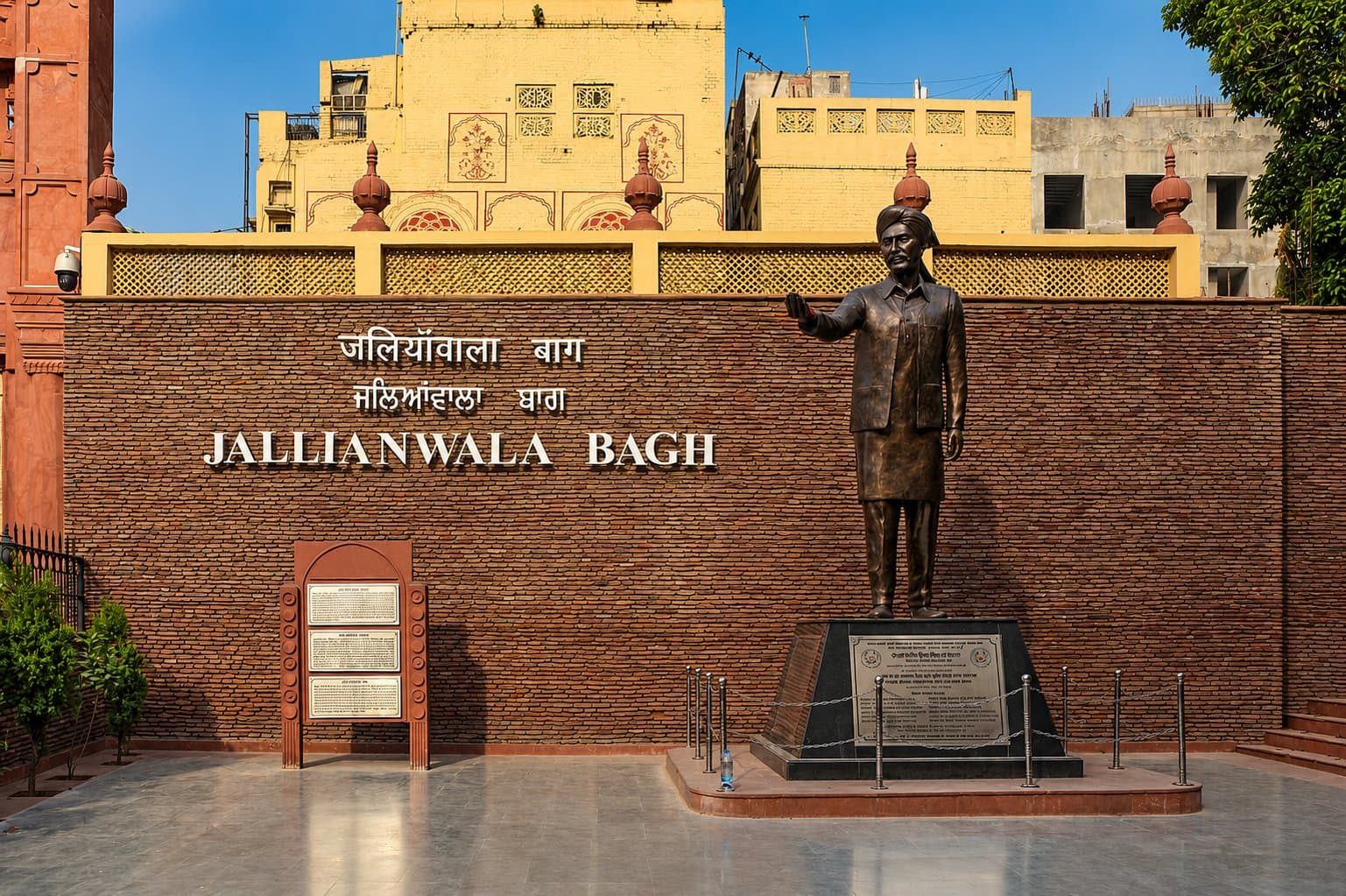
Jallianwala Bagh is one of the most significant historical sites in modern Indian history — not a monument built to commemorate a distant era, but the actual location of an event that reshaped the trajectory of India's independence movement. A short walk from the Golden Temple, it's a genuinely essential stop on any Amritsar trip, and understanding what happened here makes the visit considerably more meaningful.
What Happened on April 13, 1919
On Baisakhi day, 1919, a large crowd had gathered inside Jallianwala Bagh — then a walled public garden with limited exits — partly for the Baisakhi festival and partly in peaceful protest against the Rowlatt Act, a deeply unpopular British colonial law that allowed detention without trial. British troops under the command of General Reginald Dyer entered the enclosed garden and, without warning, opened fire on the unarmed crowd, continuing until ammunition ran low. The garden's walls and limited exits meant many in the crowd had nowhere to escape to.
How Many Died: A Figure That's Still Disputed
The exact death toll remains genuinely disputed to this day. The official British inquiry at the time cited 379 deaths, a figure widely regarded as a significant undercount even by contemporary standards; Indian sources and later estimates have put the real number considerably higher, with widely cited figures exceeding 1,000. We'd rather present this honestly as a disputed figure than state a single number as settled fact — what's not disputed is that it was a mass killing of unarmed civilians, including women and children, at a peaceful gathering.
Why It Became a Turning Point
Jallianwala Bagh's significance goes beyond the scale of the killing itself. It fundamentally shifted Indian public opinion and galvanised the independence movement in a way few single events did — moderate voices who had previously sought reform within the British colonial system increasingly moved toward full independence as the goal. Rabindranath Tagore renounced his knighthood in protest. The massacre is widely regarded by historians as one of the key events that accelerated India's path toward the eventual independence movement that Mahatma Gandhi would go on to lead at national scale.
What You'll See at the Memorial Today
Jallianwala Bagh is now a preserved memorial park, maintained specifically to let visitors understand what happened here rather than simply mark the location with a plaque. The bullet-marked walls from that day have been deliberately preserved and are visible to visitors — a direct, physical link to the event rather than an abstract historical marker. The Martyrs' Well, where many in the crowd jumped in a desperate attempt to escape the gunfire, is preserved on site. A memorial flame and a museum documenting the event and its broader context are also part of the complex.
How to Visit
Jallianwala Bagh is a short walk from the Golden Temple, making it easy to combine both in the same visit — most Amritsar itineraries, including our own, do exactly this. The memorial park is generally quiet and contemplative, and visitors should expect — and show — the same respectful atmosphere appropriate to a site of this historical weight.
Planning Your Visit
Our Amritsar — Spiritual & Historical Extravaganza package includes Jallianwala Bagh as part of its 2-day/1-night itinerary from Delhi, alongside the Golden Temple, Wagah Border and Durgiana Temple. See our Golden Temple guide and places to visit in Amritsar for the rest of what a proper Amritsar trip covers.
Frequently Asked Questions
What happened at Jallianwala Bagh? On April 13, 1919, British troops under General Reginald Dyer opened fire without warning on an unarmed crowd gathered in the walled garden, continuing until ammunition ran low — the garden's limited exits meant many had nowhere to escape.
How many people died in the Jallianwala Bagh massacre? The exact figure is genuinely disputed — the official British inquiry cited 379 deaths, widely regarded as an undercount, while Indian sources and later estimates put the real number considerably higher, often cited as exceeding 1,000.
Why is Jallianwala Bagh historically significant? It's widely regarded by historians as a turning point that galvanised India's independence movement, shifting public opinion toward full independence rather than reform within the British colonial system.
What can I see at Jallianwala Bagh today? Preserved bullet-marked walls, the Martyrs' Well where many jumped to escape the gunfire, a memorial flame, and a museum documenting the event.
Is Jallianwala Bagh close to the Golden Temple? Yes — it's a short walk away, and most Amritsar itineraries, including our own, combine both in the same visit.
Get in touch to plan your Amritsar trip, or browse our Amritsar weekend package which includes Jallianwala Bagh as part of the itinerary.