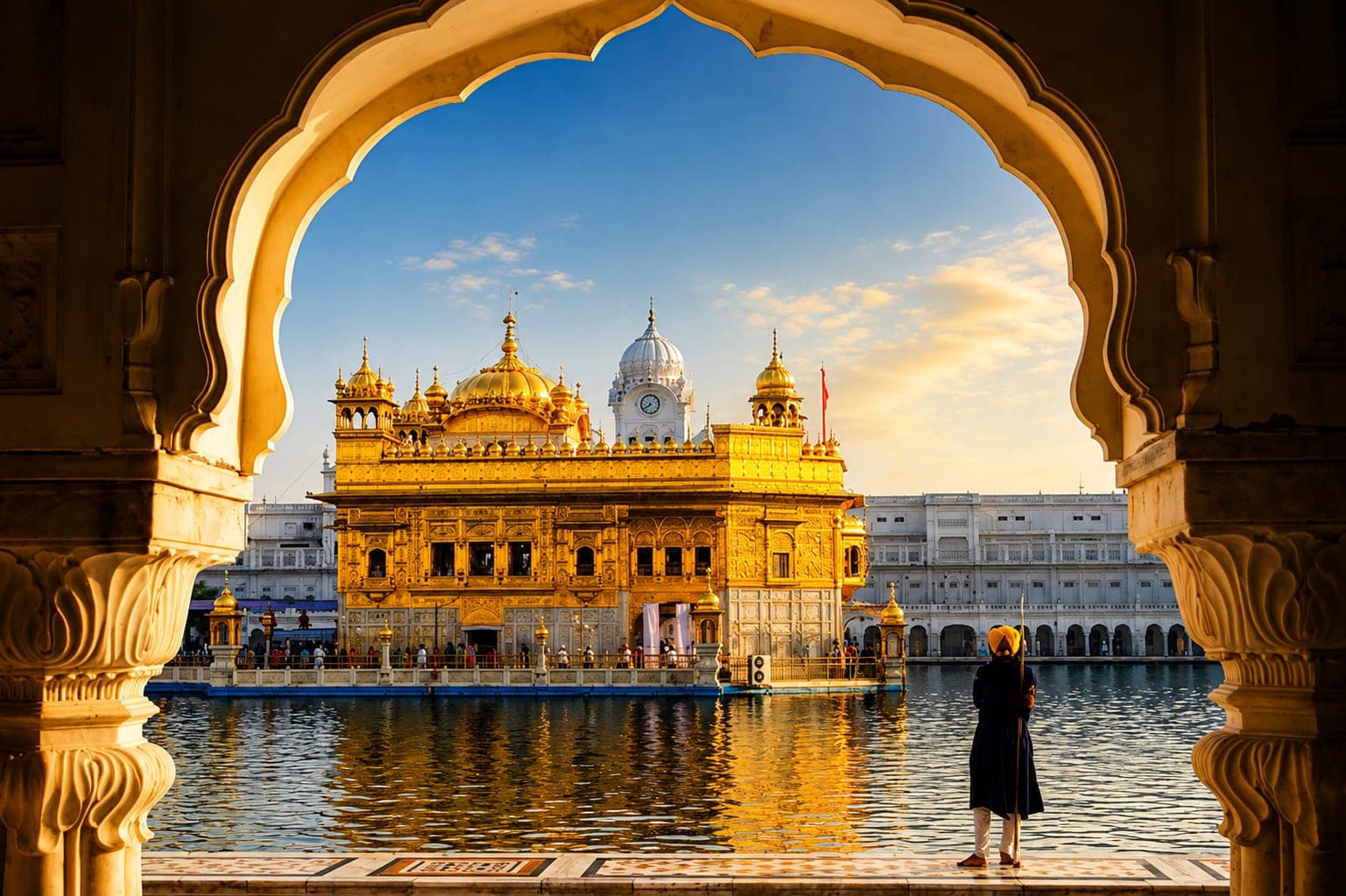
The Golden Temple (Harmandir Sahib) in Amritsar is Sikhism's holiest shrine and one of India's most visited religious sites — and it's also one of the few places where the history, the architecture and the daily experience of visiting are all genuinely worth understanding in depth before you go, rather than just showing up for a photo.
The Real History Behind the Golden Temple
The temple's story starts with Guru Ram Das, the fourth Sikh Guru, who excavated the sacred tank — the Amrit Sarovar, or "pool of nectar" — that the temple now sits within. The temple structure itself was completed under the fifth Guru, Guru Arjan Dev, who in 1604 installed the Guru Granth Sahib, Sikhism's central scripture, inside it — the first time it was formally placed in a permanent shrine. The gold that gives the temple its name came later: Maharaja Ranjit Singh, the Sikh Empire's founder, had the upper floors gilded with gold in the early 19th century, giving the shrine both its literal and popular name.
Architecture and the Four Doors
One detail that genuinely sets the Golden Temple apart from most religious architecture: it has four entrances, one on each side, deliberately symbolising that people of every direction, caste, religion and background are equally welcome inside — a direct architectural expression of Sikhism's core principle of equality. The temple itself sits in the middle of the Amrit Sarovar, connected by a causeway, with its gold-plated upper structure reflecting in the water — the image most people picture when they think of the Golden Temple.
The Langar: One of the World's Largest Free Kitchens
The langar — the Golden Temple's community kitchen — is as significant to the experience as the shrine itself, and arguably more remarkable. It serves free meals to every single visitor, regardless of religion, caste, nationality or background, every single day, feeding tens of thousands of people in a typical day and considerably more on major festival days. It runs on volunteer labour (sevadars) and donated supplies, and sitting down for a meal there — simple dal, roti and rice, eaten on the floor alongside strangers from every walk of life — is one of the most genuinely moving, levelling experiences available at any religious site in India. Visiting without eating at the langar means missing a core part of what the Golden Temple actually represents.
Akal Takht
Within the complex sits the Akal Takht, one of five Takhts (seats of temporal authority) in Sikhism, representing the faith's historical balance between spiritual and temporal authority. It's a significant stop in its own right, not just an adjunct to the main shrine.
Visitor Etiquette: What to Know Before You Go
Covering your head is mandatory for everyone, regardless of faith — headscarves are available at the entrance if you don't bring your own. Shoes must be removed and left at the designated counters, and visitors wash their feet in the shallow water channel at the entrance before walking the marble parikrama (circumambulation path) around the sarovar. Modest dress is expected, and the atmosphere throughout the complex is genuinely reverent — quiet voices, no loud behaviour, and basic respect for an active, functioning place of worship rather than a tourist attraction.
Timings and the Best Time to Visit
The Golden Temple is open 24 hours a day, and the langar runs continuously — there's no official closing time. Early morning, before sunrise, is widely considered the most atmospheric time to visit, with the complex quieter and the recitation of Gurbani (hymns) creating a genuinely different mood than the busier daytime hours. The temple is illuminated at night, with its gold structure and the lit complex reflecting beautifully in the sarovar — evening visits are a strong alternative if an early start isn't realistic. Around major Sikh festivals — Baisakhi in April, Guru Nanak Jayanti and Bandi Chhor Divas (which coincides with Diwali) — the temple is at its most spectacular, decorated and illuminated, though also considerably more crowded.
How Long Should You Spend Here?
A genuine, unhurried visit — walking the parikrama, sitting inside the main shrine for a while, eating at the langar, and taking in the complex at a relaxed pace — realistically takes 2 to 3 hours. Rushing through in under an hour means missing most of what actually makes the Golden Temple worth visiting in the first place.
Planning Your Visit
Our Amritsar — Spiritual & Historical Extravaganza package includes a proper Golden Temple visit as part of a 2-day/1-night weekend trip from Delhi, alongside the Wagah Border ceremony and Jallianwala Bagh — see our Wagah Border ceremony guide and Jallianwala Bagh history guide for the rest of what a proper Amritsar trip covers.
Frequently Asked Questions
What is the history of the Golden Temple? It was founded by Guru Ram Das, the fourth Sikh Guru, who excavated the sacred Amrit Sarovar tank. The temple structure was completed under the fifth Guru, Guru Arjan Dev, who installed the Guru Granth Sahib there in 1604. Maharaja Ranjit Singh gilded the upper floors with gold in the early 19th century, giving the temple its name.
Why does the Golden Temple have four doors? To symbolise that people of every direction, caste, religion and background are equally welcome — a direct architectural expression of Sikhism's principle of equality.
Is the langar at the Golden Temple really free? Yes — it serves free meals to every visitor regardless of background, every day, feeding tens of thousands of people daily, run entirely by volunteers on donated supplies.
What should I wear to visit the Golden Temple? Modest clothing, and a head covering is mandatory for everyone — headscarves are available at the entrance if you don't bring your own. Shoes must be removed before entering.
What are the Golden Temple's visiting hours? It's open 24 hours a day, with the langar running continuously — there's no official closing time.
What is the best time to visit the Golden Temple? Early morning before sunrise for the quietest, most atmospheric experience, or evening to see it illuminated. Major festivals like Baisakhi, Guru Nanak Jayanti and Bandi Chhor Divas (Diwali) are the most spectacular but also the most crowded times.
How much time should I spend at the Golden Temple? 2 to 3 hours for an unhurried visit that includes the parikrama walk, time inside the main shrine, and a meal at the langar.
Get in touch to plan your Amritsar trip, or browse our Amritsar weekend package for the full itinerary.