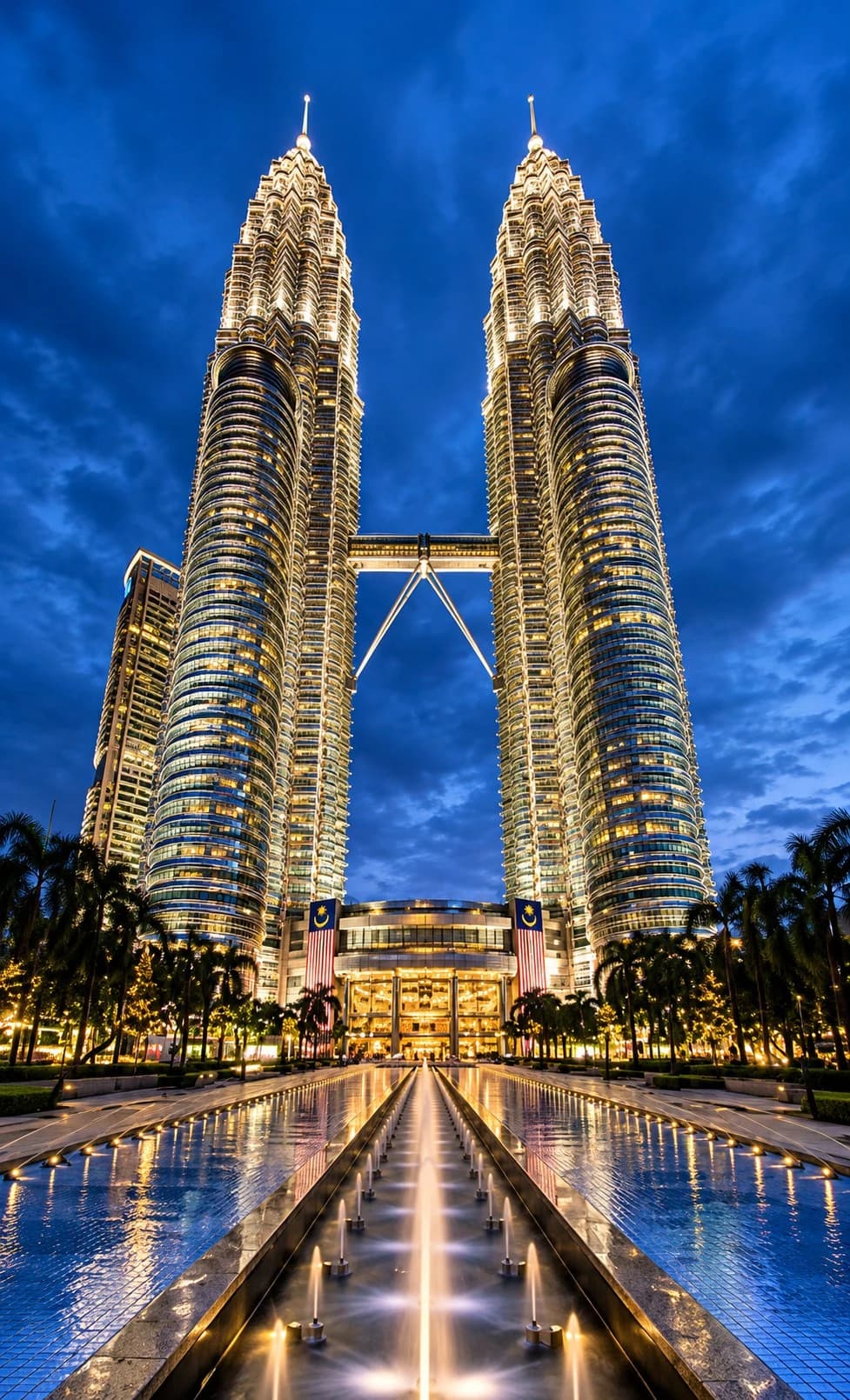
Malaysia tends to get undersold against Thailand and Bali on Indian travellers' shortlists, which is a little odd given how directly it addresses the two things that usually make or break a first Southeast Asia trip: genuinely easy entry, and food that doesn't require a daily workaround. Kuala Lumpur's skyline, Batu Caves' Hindu temple complex, Langkawi's beaches and Penang's street-food culture add up to a country that's both easy to plan and easy to actually enjoy once you land.
This guide works through what matters for planning that trip: how Kuala Lumpur, Genting, Langkawi and Penang fit together, the current visa-free entry process, realistic costs, and why Malaysia's food scene in particular tends to work unusually well for Indian travellers. Shubh Mangal Yatra arranges customised Malaysia itineraries through our travel network rather than a single fixed package, and we've noted where that's relevant through this guide, but everything here stands on its own for planning the trip yourself too.
Where Is Malaysia Located?
Malaysia sits in Southeast Asia, split across two distinct regions: Peninsular Malaysia (bordering Thailand to the north, with Singapore across a causeway to the south) and East Malaysia (Sabah and Sarawak, on the island of Borneo, separated from the peninsula by the South China Sea). Almost all Indian tourist itineraries focus on Peninsular Malaysia — Kuala Lumpur, Genting Highlands, Langkawi, Penang and Malacca — rather than Borneo's rainforests and islands, which function as a genuinely separate trip.
Kuala Lumpur, the capital, sits roughly in the centre of the peninsula's west coast, making it the natural hub for onward travel to Genting (inland, uphill), Penang and Langkawi (both north), and Malacca (south).
Why Visit Malaysia?
Malaysia's case rests on a few genuine strengths. Kuala Lumpur delivers a proper modern Asian capital — the Petronas Twin Towers, a developed metro system, and a food scene that blends Malay, Chinese and Indian cuisine into something distinct from any one of them. Batu Caves, a Hindu temple complex inside limestone caves just outside the city, is a significant pilgrimage and cultural site that resonates particularly with Indian travellers given Malaysia's large, long-established Tamil-origin community. Genting Highlands adds a cool-climate hill-resort day trip or overnight within easy reach of KL, while Langkawi and Penang cover beach and heritage-town travel respectively, each a short domestic flight away.
For Indian travellers specifically, the practical case is strong: visa-free entry for short tourist stays, extensive direct flight connectivity from multiple Indian cities, and a food and cultural landscape shaped in real part by a multi-generational Indian diaspora — meaning genuine South Indian food, Hindu temples and Tamil-speaking communities are a normal part of the country rather than a tourist accommodation.
Best Time to Visit Malaysia
| Season | Months | What to Expect | Best For |
|---|
| Peninsula dry season (west coast) | December–February | Lower rainfall on the west coast (KL, Langkawi, Penang) | First-time visitors, island time in Langkawi |
| Inter-monsoon | March–May, September–November | Variable, generally warm with regular showers | Flexible travellers, lower prices |
| East coast monsoon | November–February | Heavier rain on the peninsula's east coast | Avoid east-coast islands (Perhentian, Tioman) in this window |
| Year-round | — | Hot and humid throughout, Malaysia sits near the equator | Kuala Lumpur, Genting and Penang work reasonably well year-round |
Malaysia's weather is genuinely more regionally split than most single-country guides suggest — the west coast (KL, Langkawi, Penang) and east coast run on different monsoon patterns, so "best time" depends partly on which part of the country you're prioritising. For a KL-plus-Langkawi-or-Penang itinerary, December through February tends to be the most reliable window. These are general seasonal patterns rather than a forecast; check closer to your travel dates, since any given year can run wetter or drier than typical.
Malaysia Weather
Malaysia has an equatorial climate — consistently hot and humid year-round, with daytime temperatures generally in the low-to-mid 30s Celsius across the lowlands. Genting Highlands, at altitude, runs noticeably cooler and is a genuine relief from KL's heat and humidity, part of why it's such a popular quick escape. Expect regular rain showers in most months regardless of season; it's rarely a question of "will it rain" so much as "for how long."
Kuala Lumpur: The Capital
Kuala Lumpur anchors almost every Malaysia itinerary. The Petronas Twin Towers — for a long stretch the tallest buildings in the world, and still Malaysia's defining landmark — offer both a skybridge (connecting the two towers partway up) and an observation deck near the top, both requiring separate timed-entry tickets that are worth booking in advance given daily visitor caps. KLCC Park, at the towers' base, is the best spot for the classic evening photo of the towers lit up.
Batu Caves, around 30 minutes from central KL, is a significant Hindu temple complex built into limestone caves, marked by a towering gold statue of Lord Murugan and a steep flight of 272 colourful steps up to the main cave temple. It's both a working pilgrimage site and one of Malaysia's most-visited attractions, and is worth visiting with modest dress and a reasonable amount of time (not a quick drive-by stop). Elsewhere in the city, Merdeka Square and the surrounding colonial-era architecture, the Central Market for handicrafts, Bukit Bintang for shopping and nightlife, and the Thean Hou Temple (one of the largest Chinese temples in Southeast Asia) round out a well-paced two-to-three-day city stay.
Genting Highlands: The Hill-Resort Day Trip
Genting Highlands sits roughly an hour from KL by road, at an elevation that brings a genuinely cooler climate than the capital — a deliberate draw for both Malaysian and international visitors. The Genting Skyway cable car (one of the longest in Southeast Asia) is the scenic way up, and the resort complex itself combines a casino, Genting SkyWorlds theme park, and hotel towers built specifically around the cooler mountain air. It works well as either a long day trip from KL or a one-night addition for travellers who want a genuine change of pace without a flight.
Langkawi: The Island Escape
Langkawi, an archipelago off Malaysia's northwest coast, is reached by a roughly one-hour domestic flight from KL (or a longer ferry route from Penang) and functions as Malaysia's main beach-and-island destination for international visitors. The Langkawi Sky Bridge — a curved pedestrian bridge suspended high above the rainforest, reached via cable car — is the island's signature attraction, paired with sweeping views over the Andaman Sea. Pantai Cenang is the main beach strip, with sunset-watching, water sports and a cluster of beachfront restaurants and bars. Langkawi is also a duty-free zone, making it a popular stop for shopping on alcohol, chocolate and electronics alongside its beach appeal.
Penang: George Town and Malaysia's Food Capital
Penang, reached by a short domestic flight or a road-and-bridge route from KL, centres on George Town, a UNESCO World Heritage-listed old town known for its mix of colonial-era architecture, Chinese shophouses, and an internationally recognised street-art scene (look for the wrought-iron caricatures and painted murals scattered through the old streets). Penang Hill offers a funicular railway up to cooler air and city views, and the Kek Lok Si Temple, one of the largest Buddhist temple complexes in Southeast Asia, is a short drive from George Town.
Penang's real reputation, though, is as Malaysia's food capital — hawker-stall cooking here is taken seriously enough to draw dedicated food trips on its own, and it's worth building unstructured time into a Penang stay specifically for eating rather than treating meals as a break between sights.
Malacca (Melaka): The Historic South
Malacca, a couple of hours south of KL by road, is another UNESCO World Heritage city, built around a multicultural trading-port history that predates Malaysia itself — Portuguese, Dutch and British colonial layers are all visible in its architecture, most famously the red Dutch Square buildings and the ruins of A Famosa fort. Jonker Street's night market and the Malacca River cruise are the city's best-known present-day draws. Malacca works well as a day trip from KL or an overnight stop for travellers continuing a longer peninsula circuit.
Things to Do in Malaysia
Beyond the named attractions, a few activities cut across a well-planned Malaysia trip: a street-food crawl in Penang specifically (rather than treating one meal as "the food stop"), the Petronas Towers at night for photography, a Batu Caves visit timed for morning before the day's heat builds, and at least one proper hawker-centre meal in KL itself, where Malay, Chinese and Indian stalls typically sit side by side. Langkawi adds water sports and island-hopping boat trips; Genting adds theme-park time if travelling with children.
Malaysia Nightlife
Kuala Lumpur's nightlife centres on Bukit Bintang, spanning rooftop bars, clubs and a dense restaurant scene, with a more relaxed, multicultural character than some of the region's more overtly party-focused destinations. Langkawi's Pantai Cenang has a beachfront bar scene built around sunset, while Penang and Malacca are comparatively quieter in the evenings, built more around night markets and street food than clubs. As a majority-Muslim country, Malaysia's public alcohol and nightlife culture is more measured than Thailand's — available and normal in tourist areas, but not the organising feature of most neighbourhoods.
Malaysia Shopping
Kuala Lumpur's Bukit Bintang area and malls like Suria KLCC (at the base of the Petronas Towers) cover branded and luxury shopping; Central Market and the Chinatown area around Petaling Street are the better bet for handicrafts, souvenirs and bargaining. Langkawi's duty-free status makes it a genuine stop for alcohol, chocolate and electronics specifically. Penang's George Town leans toward art, antiques and local craft shops rather than mass retail. Bargaining is expected at markets and street stalls; fixed prices apply at malls and chain stores.
Malaysian Food
Malaysian cuisine reflects the country's Malay, Chinese and Indian communities, often served alongside each other rather than kept separate — a single hawker centre will typically have stalls from all three traditions.
| Dish | What It Is |
|---|
| Nasi Lemak | Coconut rice served with sambal, anchovies, peanuts and egg — widely considered Malaysia's national dish |
| Char Kway Teow | Stir-fried flat rice noodles, a Penang hawker-food staple |
| Roti Canai | Flaky flatbread served with dhal or curry, a Malaysian-Indian breakfast staple |
| Laksa | Spicy noodle soup, with regional variations (Penang's version is notably different from others) |
| Satay | Grilled meat skewers served with peanut sauce |
| Hainanese Chicken Rice | Poached chicken with rice cooked in chicken stock, a Chinese-Malaysian staple |
| Banana leaf rice | A South Indian-style meal served on a banana leaf, widely available given Malaysia's Tamil community |
Malaysia is genuinely one of the stronger Southeast Asian destinations for Indian vegetarians specifically — the long-established Tamil-origin community means authentic South Indian vegetarian food (banana leaf meals, dosa, idli) is a normal, widely available part of the food scene rather than a special accommodation, alongside Malay and Chinese vegetarian options at most hawker centres.
Malaysia for Indian Travellers
A few practical points for planning this trip from India: Malaysia has one of Southeast Asia's largest ethnic Indian populations, historically rooted in Tamil Nadu, which shows up in daily life — Hindu temples (Batu Caves being the most visited), Tamil-language signage in some areas, and genuinely authentic South Indian restaurants, not just tourist-facing ones. English is widely spoken, a legacy of British colonial history, and is commonly used in business, education and tourism across the country, making it one of the more linguistically comfortable Southeast Asian destinations for English-speaking Indian travellers.
Card payments are widely accepted in cities and malls; cash (Malaysian Ringgit) remains useful for hawker stalls, markets and smaller towns. Connectivity is generally reliable across KL, Penang and Langkawi's main areas. For families, KL's malls and Genting's theme park offer solid child-friendly infrastructure; for groups, Malaysia's range of hotel and tour options makes coordinating a larger party straightforward.
Malaysia Visa for Indians
Indian passport holders can currently enter Malaysia visa-free for short tourist stays, under a visa-exemption arrangement that covers tourism, business, social visits and transit (though not employment) for up to 30 days per visit. This visa-free arrangement is currently in effect through 31 December 2026, as part of Malaysia's "Visit Malaysia" tourism push — worth noting because it's a time-limited arrangement that has been extended before and could change again, rather than a permanent fixture.
Before arrival, travellers need to complete the Malaysia Digital Arrival Card (MDAC) online, within 3 days of entry. Typical requirements include a passport valid for at least six months beyond your travel dates, proof of return or onward travel, proof of accommodation, and evidence of sufficient funds for the stay (commonly cited around USD 50 per day, though this isn't rigidly enforced at the border for most tourists).
Visa-exemption rules and their end date can change, and this article isn't a substitute for checking Malaysia's official immigration channels directly before you book or travel, particularly if your trip falls near or after the current 31 December 2026 cutoff. If you'd rather not track this yourself, our team can confirm the current entry requirements when you enquire about your Malaysia trip.
How to Reach Malaysia from India
Malaysia is exceptionally well connected from India, with direct flights from 11 Indian cities to Kuala Lumpur, more than most comparable Southeast Asian destinations.
| Departure City | Direct To | Approx. Flight Time |
|---|
| Delhi | Kuala Lumpur | ~5–5.5 hours |
| Mumbai | Kuala Lumpur | ~5–5.5 hours |
| Chennai | Kuala Lumpur | ~4 hours |
| Bangalore | Kuala Lumpur | ~4.5 hours |
| Hyderabad | Kuala Lumpur | ~4.5 hours |
| Kochi | Kuala Lumpur | ~4 hours |
Airlines including Air India, AirAsia X, Batik Air and Malaysia Airlines operate these routes, with Delhi carrying the highest frequency. Treat this as a general picture rather than a booking guarantee — confirm current direct-flight availability and schedules when you're ready to book, since routes and frequencies shift over time.
Kuala Lumpur International Airport
Flights land at Kuala Lumpur International Airport (KUL), roughly 45–60 minutes from the city centre by road, or a faster dedicated rail link (the KLIA Ekspres) connecting the airport directly to KL Sentral station in about 30 minutes. Licensed airport taxis, ride-hailing apps and the rail link all work reliably for the transfer into the city.
Getting Around Malaysia
| Option | Best For | Notes |
|---|
| KL metro (LRT/MRT/Monorail) | Getting around central Kuala Lumpur | Extensive, affordable, air-conditioned |
| Grab app | Point-to-point trips in most cities | Widely used ride-hailing alternative to street taxis |
| KLIA Ekspres | Airport-to-city transfer | Fast rail link, roughly 30 minutes |
| Domestic flights | KL to Langkawi, Penang | The standard way to reach the islands and northern peninsula |
| Private driver / coach | Genting, Malacca day trips | Common for shorter overland routes from KL |
KL's public transport network is genuinely extensive by regional standards, and Grab covers most gaps. Langkawi and Penang are reached by domestic flight from KL; Genting and Malacca are close enough for a private driver or scheduled coach.
Malaysia Itineraries
4 Days / 3 Nights — Kuala Lumpur Only
Day 1: Arrive, evening at KLCC Park and the Petronas Towers. Day 2: Batu Caves, Merdeka Square, Central Market. Day 3: Petronas Towers skybridge/observation deck, Bukit Bintang shopping and nightlife. Day 4: Thean Hou Temple, departure.
5 Days / 4 Nights — KL + Genting Highlands
Day 1: Arrive KL, evening at KLCC Park. Day 2: Batu Caves, Merdeka Square. Day 3: Genting Skyway cable car, resort and theme park, overnight in Genting. Day 4: Return to KL, Petronas Towers, Bukit Bintang. Day 5: Departure.
6 Days / 5 Nights — KL + Langkawi
Day 1: Arrive KL, city evening. Day 2: Batu Caves, Petronas Towers. Day 3: Fly to Langkawi, check in, beach evening. Day 4: Langkawi Sky Bridge and cable car. Day 5: Island-hopping boat trip or beach day, duty-free shopping. Day 6: Departure.
7 Days / 6 Nights — KL + Penang
Day 1: Arrive KL. Day 2: Batu Caves, Petronas Towers, Merdeka Square. Day 3: Fly to Penang, George Town walking tour. Day 4: Penang Hill, Kek Lok Si Temple, street-food evening. Day 5: George Town street art and cafes. Day 6: Return to KL, Bukit Bintang. Day 7: Departure.
8 Days / 7 Nights — Full Peninsula Circuit
Day 1: Arrive KL. Day 2: Batu Caves, Petronas Towers. Day 3: Genting Highlands day trip. Day 4: Malacca day trip — A Famosa, Jonker Street. Day 5: Fly to Penang, George Town. Day 6: Penang Hill, Kek Lok Si Temple. Day 7: Return to KL, free day. Day 8: Departure.
Splitting a Malaysia trip across KL plus one or two other regions, rather than attempting the full peninsula in under a week, keeps the trip from being eaten up by domestic flight connections and transfer time.
Planning a Malaysia Trip?
Tell our travel team your preferred travel dates, number of travellers, hotel preference and approximate budget, and we'll help you plan a suitable itinerary across Kuala Lumpur, Genting, Langkawi or Penang. Call or WhatsApp us at +91 95990 67086 — or get in touch through our enquiry form and our team will get back to you.
Malaysia Trip Cost
| Cost Category | Budget Traveller | Comfortable Traveller | Premium/Luxury Traveller |
|---|
| Flights (round trip) | Economy, advance booking | Economy, flexible dates | Premium economy or business |
| Visa | Visa-exempt (no fee for eligible tourist stays) | Visa-exempt | Visa-exempt |
| Accommodation | Hostels, budget hotels | 3–4 star hotels | 5 star resorts, pool villas |
| Local transport | LRT/MRT, Grab | Grab, some domestic flights | Private transfers, domestic flights |
| Meals | Hawker centres, street food | Mix of hawker food and restaurants | Fine dining, resort dining |
| Sightseeing & day trips | Self-arranged, group tours | Organised half/full-day tours | Private guided tours |
| Activities | Minimal | One island tour or Genting day trip | Multiple curated experiences |
Actual totals depend heavily on season, how many regions you combine, and hotel category — and INR-to-ringgit exchange rates shift over time, so we won't quote a single "this is what Malaysia costs" figure. As a general pattern, Malaysia offers strong value for food specifically (hawker-centre meals are genuinely inexpensive), with accommodation and domestic flights being where a multi-region trip's budget concentrates.
Get Your Customized Malaysia Quote
Once you have a rough sense of your dates and which regions you want to combine, our team can share current options and a realistic cost breakdown for your specific trip. Call or WhatsApp +91 95990 67086 — share your travel dates, number of travellers and preferred budget, and we'll take it from there.
Malaysia Tour Packages from India
Travel packages for Malaysia can be customised based on your preferred dates, hotel category, number of travellers, which regions you want to combine, inclusions and experiences — rather than a single fixed itinerary that may not match what you're actually looking for. A customised Malaysia package can include flights, hotel accommodation, airport and inter-city transfers, sightseeing (Batu Caves, Petronas Towers, Genting, Langkawi or Penang), local transportation, activities, meals where relevant, and a day-by-day itinerary built around your dates and the regions you want to see.
At Shubh Mangal Yatra, we arrange Malaysia trips through our travel network based on what you need rather than a fixed template — see our Malaysia trip page to request a current quotation based on your travel dates, group size and preferred regions. See our international tour packages for the broader range of destinations we help plan, or our honeymoon and luxury collections if either fits your Malaysia trip style.
Malaysia Hotels and Where to Stay
| Area | Best For | Trade-off |
|---|
| KL — KLCC / Bukit Bintang | Central location, Petronas Towers views, shopping and nightlife | Busier, more expensive than outer KL |
| KL — Chinatown / Bukit Nanas | Budget-friendly, still fairly central | Less polished than KLCC |
| Genting Highlands | Cool climate, resort and theme-park access | Limited to the resort complex itself |
| Langkawi — Pantai Cenang | Beach access, sunset views, restaurants and bars | Busiest part of the island |
| Penang — George Town | Walkable heritage architecture, street food | Fewer large resort-style hotels |
KLCC and Bukit Bintang suit most first-time visitors for their balance of central location and Petronas Towers proximity; budget travellers often do well around Chinatown. In Langkawi, Pantai Cenang covers most beach-stay needs; in Penang, George Town suits travellers prioritising walkability and food over beach access. We don't publish specific hotel names or star ratings here since availability and quality shift season to season — our team shares current, vetted options matched to your dates and budget when you enquire.
Malaysia for Every Kind of Traveller
Couples and honeymoon
Langkawi's beach resorts and sunset views, KL's rooftop dining scene, and Genting's cooler-climate getaway give Malaysia a genuine range of romantic trip styles within one country — a city chapter, a beach chapter and a hill-resort chapter, without needing three separate destinations.
Families
KL's malls, Genting's theme park, and the generally manageable logistics (strong metro system, extensive domestic flight network) make Malaysia workable for families, including with young children. Genting in particular is built with family theme-park time as a core draw.
Luxury travellers
Private pool villas in Langkawi, a private guide for KL's Batu Caves and Petronas Towers circuit, fine dining across KL and Penang, and private island-hopping charters (rather than joining a group boat tour) are where a Malaysia trip scales up meaningfully. We build these as fully private itineraries on request.
Groups
Malaysia's well-developed tour infrastructure — shared coaches, group hotel blocks, established day-tour operators for Batu Caves, Genting and island-hopping — makes it genuinely practical for groups, whether a friend circle, extended family or small corporate trip.
What to Pack for Malaysia
Pack light, breathable clothing for the heat and humidity year-round, plus a light rain layer given Malaysia's frequent showers regardless of season. Modest clothing (covered shoulders and knees) is appropriate for Batu Caves and other religious sites. Comfortable walking shoes matter for George Town and KL sightseeing, alongside a light sweater or jacket if you're adding Genting Highlands, where the cooler elevation is a genuine change from the lowlands. Carry proof of your Malaysia Digital Arrival Card (MDAC) confirmation, a universal power adapter (Malaysia uses UK-style Type G sockets), and any personal medication, since finding specific Indian brands locally isn't guaranteed outside major pharmacies.
Currency in Malaysia
The local currency is the Malaysian Ringgit (MYR). ATMs and currency exchange counters are widely available in Kuala Lumpur, Langkawi and Penang; card payments are accepted at most hotels, malls and larger restaurants, though cash remains useful for hawker centres, markets and smaller towns. INR isn't directly exchangeable in most places — convert to USD before travel or withdraw ringgit locally via ATM, and check the current exchange rate rather than assuming a fixed INR-to-ringgit rate, since this fluctuates.
Language in Malaysia
Malay (Bahasa Malaysia) is the official language, but English is widely spoken as a legacy of British colonial history and is commonly used in business, education and tourism — among the more English-comfortable destinations in Southeast Asia for Indian travellers. Mandarin and various Chinese dialects, along with Tamil, are also widely spoken given Malaysia's multicultural population, particularly in Penang and parts of KL.
Is Malaysia Safe?
Malaysia is generally considered a safe destination for tourists, with a well-established, modern tourism infrastructure across its main destinations. Standard precautions apply: use Grab or licensed taxis, keep valuables secure in crowded markets and nightlife areas, and exercise normal caution around petty theft in busy tourist zones like Bukit Bintang. As a majority-Muslim country, modest dress and respectful behaviour at religious sites (including Hindu and Buddhist temples, not just mosques) is expected. As with any international destination, check current government travel advisories closer to your travel dates.
Malaysia Travel Tips
| # | Tip |
|---|
| 1 | Complete the Malaysia Digital Arrival Card (MDAC) online within 3 days of arrival |
| 2 | Confirm the current visa-free arrangement is still active before booking, especially for travel near or after 31 December 2026 |
| 3 | Book Petronas Towers skybridge/observation deck tickets in advance — daily visitor numbers are capped |
| 4 | Dress modestly at Batu Caves and other religious sites |
| 5 | Visit Batu Caves in the morning to avoid the worst of the midday heat on the 272 steps |
| 6 | Use the KLIA Ekspres rail link for a fast, reliable airport-to-city transfer |
| 7 | Use the Grab app for reliable point-to-point transport across most cities |
| 8 | Try banana leaf rice at least once — it's a genuine, widely available Malaysian-Indian specialty |
| 9 | Build unstructured eating time into a Penang stay specifically for its hawker food |
| 10 | Pack a light jacket if adding Genting Highlands — the elevation genuinely changes the climate |
| 11 | Carry a universal power adapter — Malaysia uses UK-style Type G sockets |
| 12 | Keep both cash and a card on hand — card acceptance thins out at hawker centres and markets |
| 13 | Bargain at markets and street stalls; prices at malls and chain stores are fixed |
| 14 | Use Langkawi's duty-free status for alcohol, chocolate and electronics specifically |
| 15 | Book inter-city domestic flights (KL to Langkawi or Penang) with a reasonable buffer either side |
| 16 | Respect photography restrictions at religious sites — ask before photographing worshippers |
| 17 | Stay hydrated and pace outdoor sightseeing around the midday heat and humidity |
| 18 | Check current entry fees at attractions, since these can change |
| 19 | Carry personal medication from home; specific Indian brands aren't guaranteed locally |
| 20 | Confirm your airline's current direct-flight schedule when booking |
| 21 | Expect rain most months — carry a compact umbrella or light raincoat regardless of season |
| 22 | Split a multi-region trip across no more than two or three regions if you have under a week |
| 23 | Check current travel advisories closer to your travel dates, as with any international trip |
Malaysia vs Other Destinations
| Comparison | Malaysia's Edge | The Alternative's Edge |
|---|
| Malaysia vs Thailand | Easier English communication, strong Indian food scene, less touristed | Thailand has more established beach/island infrastructure and nightlife scale |
| Malaysia vs Singapore | Noticeably cheaper, more varied regions (beach, hill resort, heritage towns) | Singapore is more compact, polished and straightforward to plan |
| Malaysia vs Bali | More destination variety (city, hill resort, island, heritage town) in one country | Bali is a single island, simpler to plan, strong villa culture |
None of these is a strictly better choice — Thailand suits travellers prioritising beach and nightlife scale; Singapore suits those wanting maximum convenience in minimum time; Bali suits those who want one island done well. Malaysia suits travellers who want genuine regional variety, strong English communication and an unusually good fit for Indian food and culture, within one well-connected country.
Frequently Asked Questions
Is Malaysia worth visiting? Yes — for travellers who want a city, a hill resort, a beach island and a heritage town within one easy-to-navigate country, Malaysia covers genuine variety without demanding complex logistics.
Why is Malaysia famous? For the Petronas Twin Towers, Batu Caves, its multicultural Malay-Chinese-Indian food scene, and island destinations like Langkawi.
What is the best time to visit Malaysia? December to February tends to be the most reliable window for a KL-plus-Langkawi-or-Penang trip, though Malaysia's equatorial climate means heat, humidity and rain are present most of the year.
How many days are enough for Malaysia? 4 days covers Kuala Lumpur alone; 6–7 days lets you add Genting, Langkawi or Penang; 8+ days allows a fuller peninsula circuit.
Is Malaysia expensive? Generally one of the better-value Southeast Asian destinations for Indian travellers, particularly for hawker-centre food, with accommodation and domestic flights concentrating a multi-region trip's cost.
How much does a Malaysia trip cost from India? It depends heavily on season, number of regions combined, and hotel category — contact our team with your dates and group size for a current estimate rather than a fixed figure.
Is Malaysia safe for Indians? Yes, generally — Malaysia has a modern, well-established tourism infrastructure and a significant, long-settled Indian community, which many Indian travellers find makes the country feel unusually familiar.
Do Indians need a visa for Malaysia? Not for short tourist stays — Indian passport holders currently enter visa-free for up to 30 days under an arrangement in effect through 31 December 2026, though this has a defined end date and should be reconfirmed before travel.
How many days can Indians stay in Malaysia visa-free? Up to 30 days per visit, for tourism, business, social visits or transit — not for employment.
What is the Malaysia Digital Arrival Card (MDAC)? An online pre-arrival registration required within 3 days of entry, alongside standard passport and onward-travel checks.
What are the best places to visit in Malaysia? The Petronas Twin Towers, Batu Caves, Genting Highlands, Langkawi's Sky Bridge, and Penang's George Town cover the core highlights.
What are the best things to do in Malaysia? A Batu Caves and Petronas Towers day in KL, a Genting Highlands cable-car trip, island-hopping in Langkawi, and a street-food crawl in Penang.
What should I eat in Malaysia? Nasi lemak, char kway teow, roti canai, laksa and banana leaf rice cover the essentials.
Is vegetarian food available in Malaysia? Yes, genuinely well — Malaysia's established South Indian community means authentic vegetarian banana leaf meals, dosa and idli are widely available, alongside Chinese and Malay vegetarian options.
Is Malaysia good for couples? Yes — Langkawi's beaches, KL's dining scene and Genting's hill-resort change of pace give couples several distinct romantic settings within one trip.
Is Malaysia good for families? Yes — KL's malls, Genting's theme park, and strong public transport and domestic flight networks make it manageable with children.
Should I choose Langkawi or Penang? Langkawi suits travellers prioritising beaches and island time; Penang suits those wanting heritage architecture, street art and a serious food-focused stop.
Can KL and Genting be combined? Yes, easily — Genting is about an hour from KL by road and works well as a day trip or one-night addition.
Can KL and Langkawi be combined? Yes — connected by a roughly one-hour domestic flight, this is one of the most common Malaysia itinerary combinations.
What is the currency of Malaysia? The Malaysian Ringgit (MYR); cards are widely accepted in cities and malls, with cash useful for hawker centres and markets.
Can Indians use cards in Malaysia? Yes, at most hotels, malls and larger restaurants, though carrying some ringgit cash is sensible for hawker stalls and markets.
How do I get around Malaysia? KL's LRT/MRT and Grab cover the city; domestic flights connect Langkawi and Penang; a private driver or coach covers shorter routes like Genting and Malacca.
How do I reach Malaysia from Delhi? Direct flights connect Delhi to Kuala Lumpur, taking roughly 5–5.5 hours — confirm current schedules when booking.
How do I reach Malaysia from Chennai? Direct flights connect Chennai to Kuala Lumpur, taking roughly 4 hours — one of the shorter India-Malaysia routes.
Which Indian cities have direct flights to Malaysia? Delhi, Mumbai, Chennai, Bangalore, Hyderabad and Kochi are among 11 Indian cities with direct Kuala Lumpur connections — confirm current routes when booking.
What is Kuala Lumpur's airport called? Kuala Lumpur International Airport (KUL), connected to the city centre by the KLIA Ekspres rail link in about 30 minutes.
Is there a Malaysia tour package from India? Shubh Mangal Yatra arranges customised Malaysia trips through our travel network based on your dates, preferred regions, group size and budget — contact our team for a current quotation rather than a fixed listed package.
What should I pack for Malaysia? Lightweight breathable clothing, a light rain layer, modest wear for temple visits, comfortable walking shoes, a universal power adapter, and your MDAC confirmation.
Is Malaysia part of Southeast Asia? Yes — Malaysia spans Peninsular Malaysia (bordering Thailand and Singapore) and East Malaysia on the island of Borneo.
Plan Your Malaysia Trip with Shubh Mangal Yatra
We help arrange a customised itinerary, hotel options across Kuala Lumpur, Genting, Langkawi and Penang, airport and inter-city transfers, sightseeing and day trips, activities and experiences, and family, couple and group trips, including premium and luxury options — built around your dates rather than a fixed template.
Share your travel dates, number of travellers and preferred budget with our team, and we'll share suitable hotel options and a personalised quotation. Visit our Malaysia trip page to enquire, call or WhatsApp us at +91 95990 67086, or talk to our travel team through our enquiry form.