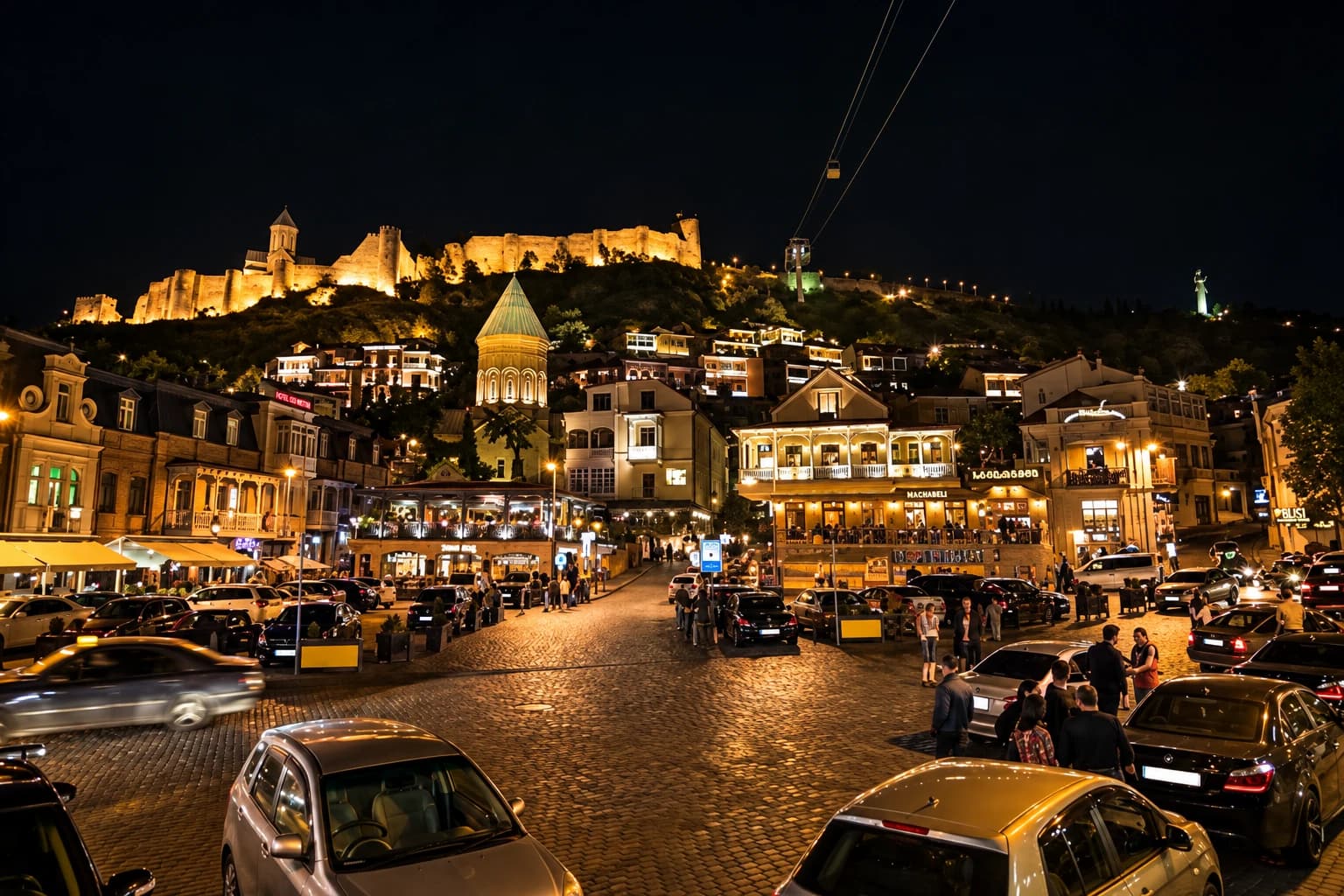
Georgia does something most international nightlife destinations don't quite manage: it lets a thousand-year-old Old Town, a glass of 8,000-year-old winemaking tradition, and a genuinely world-recognised underground techno scene exist within a few kilometres of each other. By day, Tbilisi is cobblestones and churches; by night, it's candlelit wine cellars, rooftop bars with Old Town views, and clubs that electronic-music publications rank alongside Berlin and Barcelona.
Tbilisi and Batumi offer quite different versions of "Georgia after dark." Tbilisi is the city-based, year-round scene — techno, wine bars, jazz, rooftop lounges, all walkable within a few neighbourhoods. Batumi is Georgia's Black Sea answer — beachfront bars, summer club nights and seaside dining, with a nightlife calendar that leans heavily into the warmer months. For young Indian travellers, couples and friend groups looking for a holiday with a genuine night-time dimension to it — not just sightseeing by day and an early dinner — this guide covers both cities honestly: what's real, what varies by date and venue, and what you should verify before you go.
Tbilisi Nightlife: The Heart of Georgia's Party Scene
Tbilisi's nightlife reputation isn't a tourism-brochure exaggeration — its techno scene in particular has genuine international standing, written about by outlets like Resident Advisor, i-D and Dazed, and built on a club culture that grew rapidly after the early 2010s. But the city's after-dark scene is much wider than clubbing alone.
Electronic music and underground club culture. Tbilisi's techno clubs are the city's most internationally known nightlife export — often housed in unusual former-Soviet buildings (a disused swimming pool, a hillside bridge structure) with a reputation for serious sound systems and long sets that run well past sunrise.
Wine bars and cocktail lounges. Georgia's 8,000-year-old winemaking tradition (recognised by UNESCO for its qvevri clay-vessel method) means a proper wine bar crawl is a genuine Tbilisi experience, alongside a growing cocktail-bar scene with a more international, lounge-style feel.
Rooftop bars and city views. Tbilisi's hilly geography and Old Town skyline make rooftop venues a natural fit — a relaxed, photogenic alternative to clubbing, especially for couples or a group that wants conversation over a dance floor.
Live music and jazz venues. Smaller live-music rooms and jazz bars give the city a mellower late-evening option, often in the same neighbourhoods as the louder clubs.
Late-night restaurants and Georgian cuisine. Khachapuri, khinkali and late-night Georgian dining are as much a part of a Tbilisi night out as any bar — several restaurants in the Old Town and Vera stay open well into the night.
Historic Old Town evening walks. The illuminated Old Town, the Bridge of Peace and the Narikala Fortress viewpoint are worth experiencing after dark even on a night when you're not planning to go out — it's a genuinely different city once the lights come on.
Social experiences for groups and couples. The range here is the point — a group of friends can start at a rooftop bar, move to a wine bar, and end at a techno club, while a couple can build an entire evening around dinner, a cocktail lounge and an Old Town walk without clubbing at all.
Geographically, Tbilisi's after-dark scene clusters around a few distinct neighbourhoods: the Old Town and Shardeni Street for wine bars, restaurants and an atmospheric evening walk; Fabrika and Chugureti, a former Soviet textile factory turned courtyard venue with multiple bars, street art and live DJ sets, popular with a younger, more international crowd; Vera, a quieter, more local neighbourhood of cosy bars that's developed a reputation as one of the city's most distinctive areas for a relaxed bar-hop; and Marjanishvili, known for cafés, craft-beer bars and smaller music venues. Opening hours, cover charges, age restrictions and specific events vary genuinely by venue and by date — treat anything below as a starting point for your own research, not a fixed schedule.
Thinking about building nightlife into a full Georgia holiday? Our team can help plan the sightseeing and logistics around it — get in touch to talk through dates and what you'd like the trip to include.
Best Nightclubs in Tbilisi
Three names come up repeatedly in any serious conversation about Tbilisi's club scene — but club operations, door policies and event calendars genuinely change, including temporary closures tied to licensing, renovation or broader events in the city, so verify current status directly (via the venue's own social channels or a platform like Resident Advisor) before planning a night around any of them.
Bassiani. Possibly the most internationally recognised techno club in the Caucasus, Bassiani occupies a disused Soviet-era swimming pool beneath Tbilisi's Dinamo Arena football stadium, with a capacity of roughly 1,200. It's known for a serious, bass-heavy techno sound system, long sets that often run till morning, and a club culture that's genuinely tied to Georgia's progressive, LGBTQ+-inclusive youth scene rather than being just a tourist attraction. Entry has historically involved online registration rather than simple walk-up access.
KHIDI. Built into a hillside structure under a bridge over the Mtkvari River, KHIDI runs a main techno floor alongside a smaller room for more varied music. Like Bassiani, it has typically required online registration ahead of a visit, and its booking policy and hours should be checked directly before you go.
Mtkvarze. A riverside club occupying a former 1950s restaurant building, Mtkvarze is known for floor-to-ceiling windows over the Mtkvari and weekend sets leaning toward techno and house, mostly from Georgian DJs. It won a local electronic-music award shortly after opening and has a reputation as a slightly more accessible alternative to Bassiani and KHIDI.
None of these venues publish a fixed, universal entry fee, dress code or opening-hours schedule that holds true year-round — Tbilisi's techno clubs in particular are known for late, variable start times (often well after midnight) and online ticketing or registration rather than guaranteed walk-in entry. Check age restrictions, current event listings and ticket availability directly through each venue's official channels or Resident Advisor before building a night around a specific club.
Best Bars and Evening Experiences in Tbilisi
Clubbing isn't the only (or even the main) way to spend a night in Tbilisi — and for couples or travellers who'd rather skip the 2am entry queue, the city's bar and wine scene is arguably the stronger draw.
Traditional Georgian wine bars, concentrated in the Old Town and around Shardeni Street, pour local wine by the glass alongside Georgian cheese and bread pairings — a genuinely different, slower-paced evening than a cocktail bar, and a good fit for couples or small groups wanting conversation over volume.
Cocktail bars and stylish lounges have grown considerably in Tbilisi in recent years, often in Vera or around Fabrika, with a more international bar-menu feel — suited to groups of friends wanting a polished evening before heading elsewhere.
Rooftop venues with city views make the most of Tbilisi's hills and Old Town skyline — a relaxed, photogenic option for couples especially, and a good opening act to a longer night for groups.
Jazz and live-music experiences, usually in smaller, more intimate rooms, give the city a mellower alternative — worth seeking out if clubbing isn't the point of your evening.
Late-night Georgian dining rounds out most nights out — khachapuri (cheese-filled bread) and khinkali (dumplings) are the two dishes worth having at least once, and several Old Town and Vera restaurants serve well past typical Indian dinner hours.
Evening walks through the illuminated Old Town, the Bridge of Peace and up to the Narikala Fortress viewpoint cost nothing and work for literally every kind of traveller — arguably the single most universally recommendable "nightlife" activity in the city.
For couples: wine bars, rooftop venues and an Old Town walk build a genuinely romantic evening without needing a club at all. For groups of friends: Fabrika's courtyard bars or a Vera bar-hop offer a lower-commitment, easy-to-adjust-on-the-fly evening that can escalate toward a club later if the group's up for it.
Batumi Nightlife: Beach Parties and Coastal Evenings
Batumi, Georgia's Black Sea resort city on the Adjara coast, offers a nightlife experience built around the beach and the boulevard rather than Tbilisi's underground club culture — a genuinely different holiday mood if you're combining both cities on a longer trip.
Beachfront bars and cafés line much of Batumi's coastline, built around daytime lounging that extends naturally into the evening as the temperature drops.
Summer clubs and DJ events form the core of Batumi's party scene, with several venues doubling as a daytime pool/beach lounge and a nightclub after dark during the warmer months.
Batumi Boulevard after sunset is the city's signature evening experience — a long seafront promenade with cafés, street performers and a genuinely different energy once the lights and fountains come on.
Rooftop lounges and seaside dining mirror Tbilisi's rooftop scene but with a sea view instead of an Old Town one — a relaxed option for couples specifically.
Seasonal music festivals and concerts have become a growing part of Batumi's calendar in recent summers, though specific festival dates and lineups change year to year — check current listings rather than assuming a repeat schedule.
Casinos are a legal and genuinely significant part of Batumi's entertainment economy — the city has attracted visitors (notably from neighbouring Turkey, where casino gambling is restricted) specifically for this reason for years. If gambling is something you'd consider as one part of an evening, treat it the way you would anywhere: set a firm budget before you walk in, never chase losses, and treat it purely as entertainment spending rather than a way to fund the rest of your trip.
Venues such as Soho, Sector 26 and Garage Night Club have been associated with Batumi's nightlife and beach-club scene in travel guides and local listings, but naming conventions, ownership and operating formats around Batumi's beach clubs change fairly often between seasons — treat these as names worth searching for current information on rather than a confirmed, bookable list, and verify opening status, hours and events directly before you go.
Batumi's clubbing scene is genuinely more seasonal than Tbilisi's — summer (roughly June to August) brings the liveliest beach-club atmosphere, while the city noticeably quietens outside that window, with some beachfront venues operating reduced hours or closing entirely until the next season.
Tbilisi vs Batumi: Which Is Better for Nightlife?
| Factor | Tbilisi | Batumi |
|---|
| Clubbing & electronic music | Strong, internationally recognised techno scene, available most of the year | Present but more casual, concentrated in summer beach clubs |
| Beach parties & summer events | Not applicable (landlocked) | The main draw — beachfront clubs and DJ events |
| Wine bars & cocktails | Extensive, genuinely strong Old Town and Vera scene | Present, but a smaller scene than Tbilisi |
| Live music & cultural experiences | Strong — jazz venues, live music rooms, historic Old Town | Present, more seasonal and festival-driven |
| Romantic evening options | Rooftop bars, wine bars, illuminated Old Town walks | Boulevard walks, seaside dining, rooftop sea views |
| Best season | Largely year-round for bars/clubs; check indoor-venue schedules in winter | Summer (roughly June–August) for the full beach-club atmosphere |
| Ideal traveller profile | Clubbing/techno enthusiasts, wine-and-culture travellers, year-round visitors | Beach-and-party travellers, summer-specific trips, casino-curious travellers |
Our honest take: choose Tbilisi if a genuine clubbing and music scene, wine culture, or year-round flexibility matters more to your trip; choose Batumi if a beach-party, seaside-boulevard evening in peak summer is specifically what you're after. Many longer trips do both — Tbilisi for the city-based nightlife and sightseeing, Batumi added as a coastal extension — though that needs a longer itinerary than a quick 4-day trip, covered below.
Georgia Nightlife Budget for Indian Travellers
The figures below are illustrative, per-person estimates for one night out in Tbilisi — not live, verified prices. They assume a shoulder-season visit, a small group splitting transport costs, and a mix of a bar/restaurant stop followed by a club. Actual costs shift with venue, specific event, season, group size and the INR-to-GEL exchange rate at the time, so treat these as planning ranges rather than quotes.
| Cost Category | Budget Night | Mid-Range Night | Premium Night |
|---|
| Transport (to/from venues) | ₹300–600 (shared ride) | ₹600–1,000 (private ride) | ₹1,200+ (private throughout) |
| Drinks (alcoholic or non-alcoholic) | ₹800–1,500 | ₹1,800–3,000 | ₹4,000+ |
| Food / late-night dining | ₹500–900 | ₹1,000–1,800 | ₹2,500+ |
| Club tickets or entry | ₹0–1,500 (varies by venue/event) | ₹1,500–3,000 | ₹3,500+ (premium events) |
| Optional extras (rooftop venue cover, casino budget, etc.) | — | ₹1,000–2,000 | ₹3,000+ |
| Approximate total per person | ₹1,600–4,500 | ₹5,900–10,800 | ₹14,200+ |
A few ways to plan sensibly rather than guess: set a fixed nightlife budget per night before you travel rather than deciding in the moment, check whether a club you're interested in uses paid online registration (common at Tbilisi's techno clubs) so you're not caught out at the door, split private transport costs across your group rather than each booking separately, and treat casino or premium-venue spending as a deliberate, capped decision rather than something that happens by default. Get in touch with our team if you'd like help planning a realistic overall holiday budget that includes a night-life allowance alongside sightseeing and stays.
Is Georgia Nightlife Safe for Indian Tourists?
Georgia, and Tbilisi specifically, is generally regarded as a safe destination for tourists after dark, including for solo travellers — Georgia's own tourism authority cites a strong international safety-index ranking, and most travel-safety assessments describe central, well-lit areas as comfortable to walk even late at night. That said, "generally safe" isn't the same as "no precautions needed," and most of the realistic risks around nightlife are about scams and carelessness rather than violent crime. Sensible practices:
- Use trusted transport options at night. Bolt and Yandex Go are the main ride-hailing apps in Georgia (Uber does not currently operate there) and are typically far cheaper and more transparent than flagging an unmarked car, especially around venues and late at night.
- Keep phones, passports and valuables secure. Carry only what you need for the night, and consider a cross-body bag or secure pocket rather than something easily snatched in a crowd.
- Check venue entry rules before arrival. Age restrictions, ID requirements and online-registration policies (common at Tbilisi's bigger techno clubs) vary by venue — confirm these in advance rather than assuming walk-in entry.
- Avoid unlicensed or unclear drink offers. As anywhere, be cautious about accepting drinks from strangers or buying from unofficial vendors outside venues.
- Watch your drinks and belongings. Drink-spiking incidents are reported as rare but not unheard of in Tbilisi's nightlife scene — keep an eye on your glass as a standard precaution, the same way you would at home.
- Travel with trusted companions, particularly later at night or in less central areas — this is good general practice rather than a Georgia-specific warning.
- Respect local laws and cultural norms. Georgia's legal drinking age is 18, drink-driving limits are strict, and club door staff make their own judgment calls on entry and behaviour — a respectful, low-drama approach goes a long way.
- Know emergency contacts and carry travel insurance. Save Georgia's emergency number (112, the country's unified emergency line) before you travel, and make sure your travel insurance is active for the duration of your trip — standard practice for any international holiday, nightlife included.
None of this is meant to alarm you — it's the same baseline caution worth applying to any international nightlife scene, and the overall picture for Georgia is a genuinely welcoming one for tourists.
Best Time to Experience Georgia Nightlife
| Season | Months | Tbilisi | Batumi |
|---|
| Spring | March–May | Indoor clubs and bars running normally; comfortable evening-walk weather | Beach clubs mostly not yet in full swing |
| Summer | June–August | Full scene, plus more outdoor/rooftop options; busiest tourist season | Peak season — beach clubs, DJ events, boulevard at its liveliest |
| Autumn | September–November | Full scene continues; comfortable evenings, thinner crowds than summer | Scene winding down through the season as temperatures drop |
| Winter | December–February | Indoor clubs, bars and jazz venues operate year-round | Largely quiet; most beach-specific venues reduce hours or close for the season |
The honest summary: Tbilisi's indoor nightlife — clubs, wine bars, jazz venues — runs throughout the year, so timing matters less there than it does for Batumi, where the beach-club scene is genuinely seasonal and concentrated in summer. If a Batumi beach-party night is a priority, build your trip around June–August; if Tbilisi's club and bar scene is the main draw, any season works, though summer brings bigger crowds and a livelier outdoor/rooftop scene generally.
Suggested 4-Day Georgia Nightlife Itinerary
Day 1: Arrive in Tbilisi, check in, and explore the Old Town in the evening — a relaxed dinner with city views to ease into the trip.
Day 2: Daytime sightseeing (Narikala Fortress, the sulphur bath district), followed by an evening of wine bars, cocktails or live music in the Old Town, Vera or Fabrika — a good night for a group that wants a lower-key start.
Day 3: More daytime sightseeing, then choose a nightclub or electronic-music event for the evening, depending on what's currently running at Bassiani, KHIDI, Mtkvarze or elsewhere — check listings a few days ahead rather than deciding on the day.
Day 4: A relaxed breakfast, any remaining sightseeing or shopping, and departure — or extend the trip if you'd like more time.
This 4-day plan deliberately keeps everything in Tbilisi. Batumi is roughly 350–370km from Tbilisi — around 5–6 hours by road, or about an hour by air, with overnight trains also running — which makes it a genuinely poor fit for a quick 4-day trip once you factor in travel time both ways. If a Batumi beach-nightlife leg matters to you, we'd suggest extending to 6–7 days total rather than squeezing it in, and checking current flight/train schedules before you build that into your plan. See our full Georgia travel guide for how a longer, sightseeing-plus-nightlife itinerary (including the Caucasus Mountains around Kazbegi and Gudauri) fits together.
Essential Nightlife Tips for Indian Travellers
| Topic | What to Know |
|---|
| Identification | Carry your passport (not a photo of it) for club entry — ID checks are standard at bigger venues, and photos on a phone typically aren't accepted. |
| Age restrictions | Georgia's legal drinking age is 18; specific venues may set their own stricter entry or drinking policies, so don't assume one club's rules apply at another. |
| Dress codes & entry policies | Policies vary by venue — some of Tbilisi's bigger clubs use online registration rather than walk-in entry. Check each venue's current policy directly rather than assuming. |
| Currency & cards | The Georgian Lari (GEL) is the local currency; cards are widely accepted at bars and clubs in Tbilisi and Batumi's main tourist areas, though carrying some cash is sensible for smaller venues and cover charges. |
| Transport after midnight | Bolt and Yandex Go are the main ride-hailing apps and generally the safer, more transparent option over unmarked street taxis late at night; Tbilisi's metro runs only until around midnight. |
| Booking tickets | Popular club nights and events, especially at Tbilisi's well-known techno clubs, often require advance online registration or tickets — don't assume you can walk in on a busy night. |
| Responsible drinking | Pace yourself, especially if you're not used to the altitude-adjacent cooler evenings or local drink strengths, and keep an eye on your group. |
| Travel insurance | Have active travel insurance for your trip dates, and know Georgia's emergency number (112) before you go out. |
Rules genuinely differ from venue to venue — a policy at one Tbilisi club doesn't necessarily apply at another, so treat every point above as "check before you go" rather than a universal guarantee.
Frequently Asked Questions
Is Georgia good for nightlife? Yes — Tbilisi has an internationally recognised techno and wine-bar scene, and Batumi offers a seasonal beach-club experience, giving the country a genuinely varied after-dark offering for a relatively compact destination.
Which city has the best nightlife in Georgia? Tbilisi, for a year-round, varied scene spanning techno clubs, wine bars, jazz venues and rooftop lounges; Batumi, specifically in summer, for a beach-party atmosphere Tbilisi can't offer.
Is Tbilisi famous for electronic music? Yes — clubs like Bassiani and KHIDI have genuine international recognition in electronic-music media, built on a techno scene that grew rapidly through the 2010s.
What are the best nightclubs in Tbilisi? Bassiani, KHIDI and Mtkvarze are the three most commonly cited — verify current event listings, entry policies and operating status directly before planning a night around any of them.
Is Batumi good for beach parties? Yes, particularly in summer (June–August), when its beachfront bars and seasonal clubs are at their liveliest; the scene thins out considerably outside that window.
How much does a night out in Georgia cost? Illustrative per-person estimates run roughly ₹1,600–4,500 for a budget night, ₹5,900–10,800 for mid-range, and ₹14,200+ for a premium night out — see our budget breakdown above for the assumptions behind these figures.
Is Georgia nightlife suitable for couples? Yes — wine bars, rooftop lounges and illuminated Old Town walks in Tbilisi, or boulevard walks and seaside dining in Batumi, suit couples well without needing to club at all.
What is the best month to visit Georgia for nightlife? Summer (June–August) for Batumi's full beach-club scene; Tbilisi's indoor nightlife runs year-round, so timing matters less if the city is your main focus.
Are there age restrictions at Georgian nightclubs? Georgia's legal drinking age is 18, though individual venues may apply their own entry or ID policies — confirm directly with the venue rather than assuming a single rule applies everywhere.
How many days are enough to explore Georgia's nightlife? 3–4 days covers Tbilisi's main nightlife neighbourhoods comfortably; add 2–3 more days if you want to include Batumi, given the 5–6 hour road journey (or roughly 1 hour by air) between the two cities.
Is Georgia suitable for a group trip with friends? Yes — Tbilisi's mix of low-commitment bar-hopping (Fabrika, Vera) and bigger club nights gives a group flexibility to adjust the evening as it goes, and Batumi's beach clubs in summer suit a livelier group trip well.
Can travellers combine nightlife with mountain and sightseeing experiences? Yes — a longer Georgia trip can combine Tbilisi's Old Town, a Caucasus Mountain circuit (Kazbegi and Gudauri), and its nightlife scene without conflict, since the mountain leg is typically a separate 2–3 day segment of the trip. See our complete Georgia travel guide for how to structure that alongside the nightlife itinerary above.
Plan a Georgia Holiday — Nightlife Included — with Shubh Mangal Yatra
We don't run a dedicated Georgia nightlife package, but our fixed Tbilisi & Batumi itinerary already bases you in Tbilisi — where most of the nightlife covered above happens — with free evenings built in that you can shape around bars, rooftop lounges or a club night. For a different mix (adding the Kazbegi/Gudauri mountain circuit, more free time in Tbilisi specifically, or a different trip length), we also build wider customised Georgia itineraries through our travel network, based on your dates, group size and what kind of evenings you're after. Whether you're planning a trip with friends who want a genuine party-and-sightseeing mix, or a couple looking for a more romantic, wine-bar-and-rooftop kind of evening, we can help shape an itinerary around it.
See our complete Georgia travel guide for places to visit, trip costs and a 7-day itinerary, or our full range of international tour packages for other short-haul options. Share your travel dates, group size and what you'd like your evenings to look like with our team, and we'll help put together a realistic plan. Visit our Georgia trip page to enquire, call or WhatsApp us at +91 95990 67086, or talk to our travel team through our enquiry form.