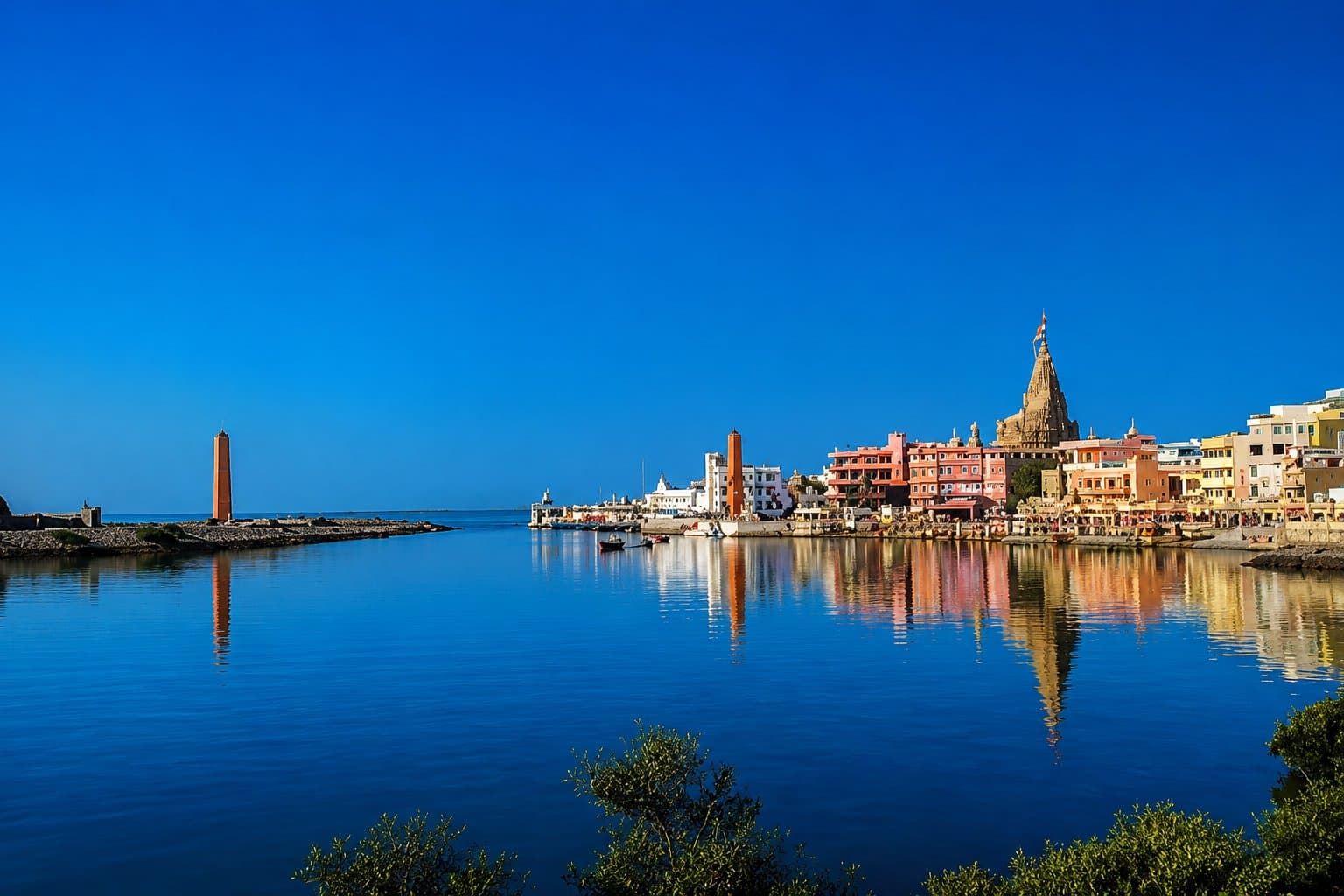
Dwarka and Somnath are two of Gujarat's most significant pilgrimage towns, sitting roughly 230 km apart along the Saurashtra coast. Most travellers visit them together rather than separately, since both are built around a single, central Shiva or Krishna shrine and a day each is enough to see what matters. Here's how the two towns work, what each temple means, and how to plan the trip.
Dwarkadhish Temple: Krishna's Ancient Capital
Dwarka is traditionally identified as the site of Dwarka Nagari, the kingdom Lord Krishna established after leaving Mathura — one of the Char Dham (the four principal pilgrimage sites of Hinduism, alongside Badrinath, Puri and Rameswaram) and one of the Sapta Puri (seven sacred cities). The Dwarkadhish Temple, also called Jagat Mandir, is a five-storey structure with intricate carving, built on the site tradition holds was Krishna's residence — though, as with most temples of this antiquity, the exact construction date is debated, with the current structure generally dated to around the 16th century over an older foundation.
The temple's inner sanctum houses Dwarkadhish — Krishna as the king of Dwarka — and the daily schedule includes multiple aartis, starting with Mangala aarti before sunrise. Most visitors combine the main darshan with a holy dip in the Gomti river nearby and a short visit to Rukmini Devi Temple, dedicated to Krishna's chief queen, a couple of kilometres from the main temple.
A short drive from Dwarka takes you to Bet Dwarka, an island shrine reached by boat, traditionally held to be where Krishna actually resided, and Gopi Talav, associated with the Gopis of Krishna's story.
Nageshwar Jyotirlinga
A few kilometres outside Dwarka sits Nageshwar Temple, home to one of the twelve Jyotirlingas — shrines where Shiva is worshipped in the form of a jyoti, or radiant light, considered the most sacred Shiva temples in Hindu tradition. Nageshwar is marked by a towering Shiva statue outside the complex and is usually visited as a half-day add-on to the main Dwarka darshan rather than a separate trip.
Somnath: The First Jyotirlinga
Somnath, roughly 230 km south of Dwarka along the coast, holds a particular place in Indian history as well as Hindu tradition: it's considered the first of the twelve Jyotirlingas, and the temple has been destroyed and rebuilt multiple times over the centuries — most famously following Mahmud of Ghazni's raid in 1024 CE — before the current structure was completed in the 1950s under Sardar Vallabhbhai Patel's initiative, built in the Chalukya style of architecture.
The temple sits directly on the Arabian Sea coast, and the evening Aarti followed by a sound-and-light show narrating the temple's history is one of the more memorable parts of a Somnath visit for most travellers. Nearby, Bhalka Tirth marks the spot tradition associates with Krishna's departure from this world, and Triveni Ghat is where three rivers are believed to meet the sea.
The Route Between Them: Porbandar
Dwarka and Somnath aren't directly connected by a short road — most itineraries route through Porbandar, roughly midway, which is worth a stop in its own right as the birthplace of Mahatma Gandhi. Kirti Mandir, built on the site of Gandhi's ancestral home, is a modest but moving stop for most travellers, and Jamnagar's Bala Hanuman Temple — with its Guinness World Record for continuous chanting since 1956 — sits on the Dwarka side of the route.
Best Time to Visit
Winter (November to February) is the most comfortable season for this circuit — coastal Gujarat gets genuinely hot from March onward, and the extended outdoor time around both temple complexes and the evening aarti crowds are far more pleasant in cooler weather. Monsoon (July-September) brings the risk of heavy rain disrupting road travel along this stretch; winter remains the safer, more predictable choice for a circuit that depends on road transport between towns.
Planning Your Trip
Our Dwarka, Somnath & Gir package covers both temples as part of a 5-day circuit from Rajkot, routing through Jamnagar and Porbandar on the way to Dwarka, then on to Somnath and a Gir National Park safari before returning to Rajkot — see the package page for the full day-by-day itinerary and current pricing.
Frequently Asked Questions
Can Dwarka and Somnath be visited in one trip? Yes — most itineraries, including ours, cover both as part of a single circuit, usually routing through Porbandar between the two.
Which is the more important temple, Dwarka or Somnath? Both hold major significance in different traditions — Dwarka as one of the Char Dham and Sapta Puri tied to Krishna, Somnath as the first of the twelve Jyotirlingas tied to Shiva. Most pilgrims visit both rather than choosing one over the other.
How far apart are Dwarka and Somnath? Roughly 230 km by road, usually covered via Porbandar, which is worth a stop in its own right for Gandhi's birthplace, Kirti Mandir.
What is Nageshwar Jyotirlinga's relation to Dwarka? Nageshwar is a short drive from Dwarka and is typically visited as a half-day add-on to the main Dwarkadhish Temple darshan, since both are Krishna/Shiva sites associated with the same town.
What's the best time to visit Dwarka and Somnath? November to February, when coastal Gujarat's weather is cool enough for comfortable outdoor sightseeing and temple visits; summer gets genuinely hot and monsoon brings travel disruption risk.
Get in touch to plan your Dwarka-Somnath pilgrimage, or see our Dwarka, Somnath & Gir package for the full circuit including a Gir National Park safari.