Bali gets recommended for almost every kind of trip — honeymoon, family holiday, solo reset, friend-group getaway — which is unusual for an island this size, and part of why it keeps showing up on Indian travellers' shortlists year after year. Ubud's rice terraces and Uluwatu's clifftop temples are a different Bali from Seminyak's beach clubs and Canggu's surf breaks, and a lot of first-time visitors try to cram all of it into one base rather than planning around the island's actual geography.
This guide works through what actually matters for planning a Bali trip from India: where to go and for how long, the current visa-on-arrival process, realistic costs, and how the main areas — Ubud, South Bali's beach towns, and the Nusa islands — fit together. Shubh Mangal Yatra arranges customised Bali itineraries through our travel network rather than a single fixed package, and we've noted where that's relevant through this guide, but everything here stands on its own for planning the trip yourself too.
Where Is Bali Located?
Bali is one of Indonesia's more than 17,000 islands, sitting in the Lesser Sunda Islands chain between Java to the west and Lombok to the east. The Bali Strait separates it from Java, and the Lombok Strait separates it from Lombok and the Gili Islands. Indonesia's capital, Jakarta, is on a different island entirely (Java), so Bali functions as its own self-contained travel destination rather than a quick add-on to a Jakarta trip.
The island is compact enough to drive across in a few hours but geographically varied — volcanic mountains (including the active Mount Agung and Mount Batur) in the centre and north, rice terraces across the central highlands around Ubud, and beaches ringing the south and west coasts. Flights land at Ngurah Rai International Airport near Denpasar, in Bali's south, which is also where most visitors base themselves for at least part of the trip.
Why Visit Bali?
Bali's appeal comes from how much genuinely different travel it packs into one island. Ubud offers rice terraces, art villages, yoga retreats and a strong vegetarian and vegan food scene. South Bali's beach towns — Seminyak, Kuta, Canggu and Uluwatu — cover everything from surf breaks and beach clubs to clifftop sunset temples. Offshore, Nusa Penida and the Gili Islands add a different pace again: snorkelling, diving and a slower island rhythm reachable by a short boat ride.
Hindu temple culture runs through daily life here in a way that's distinct from the rest of Muslim-majority Indonesia — Bali is the country's main Hindu-majority island, and temple ceremonies, offerings placed outside homes and shops, and festivals are a visible, everyday part of the island rather than a tourist performance. For Indian travellers specifically, that Hindu cultural thread, genuinely good vegetarian food in places like Ubud, several direct flight options, and a visa-on-arrival process that doesn't require advance embassy paperwork make Bali one of the more approachable first international trips.
Best Time to Visit Bali
| Season | Months | What to Expect | Best For |
|---|
| Dry season (peak) | May–September | Warm, low rainfall, busiest months, especially July–August | First-time visitors, outdoor sightseeing, beach days |
| Dry season (shoulder) | April, October | Similar weather to peak, fewer crowds | Travellers who want dry-season conditions without peak pricing |
| Wet season | November–March | Warm with regular rain, often short afternoon showers rather than all-day rain | Budget travellers, fewer crowds, lush rice-terrace scenery |
| Year-end peak | Late December–early January | Wet season weather but very high demand and pricing | Only if your dates are fixed around the holidays |
April to October generally gives the most reliable outdoor sightseeing and beach weather, with July, August and the Christmas–New Year window being the busiest and most expensive. Wet season doesn't mean constant rain — short, heavy afternoon showers followed by sun are typical in most months — and it's a genuinely reasonable time to visit for travellers prioritising lower prices and thinner crowds over guaranteed dry days. These are general seasonal patterns rather than a forecast; check closer to your travel dates, since any given year can run wetter or drier than typical.
Bali Weather
Bali has a tropical climate with consistent year-round warmth (daytime temperatures generally in the high 20s to low 30s Celsius) and humidity that's higher in the wet season. Ubud and the central highlands run slightly cooler than the coast given the elevation, which is worth factoring in if you're moving between a beach stay and an Ubud stay on the same trip. Pack for heat and humidity in every season, and carry a light rain layer if travelling November through March.
Places to Visit in Bali
| Attraction | What It Is | Time Needed | Best Time to Visit |
|---|
| Uluwatu Temple | Clifftop sea temple, Kecak fire dance performances | 2–3 hours | Late afternoon into sunset |
| Tanah Lot | Iconic sea temple on a rock formation | 1–2 hours | Sunset |
| Tegalalang Rice Terrace | Tiered rice paddies near Ubud | 1–2 hours | Morning, before tour groups arrive |
| Ubud Monkey Forest | Forest sanctuary with long-tailed macaques | 1–1.5 hours | Morning |
| Tirta Empul | Holy spring water temple, ritual purification pools | 1–1.5 hours | Morning |
| Besakih Temple | Bali's largest and holiest temple complex, on Mount Agung's slopes | Half day (with travel time) | Morning |
| Mount Batur | Active volcano, popular sunrise trek | Half day (overnight start) | Pre-dawn start for sunrise |
| Nusa Penida | Offshore island — Kelingking Beach, Angel's Billabong, Broken Beach | Full day or overnight | Dry season, calmer seas |
| Tegenungan Waterfall | Accessible waterfall near Ubud | 1–1.5 hours | Morning, after rain for fuller flow |
| Jatiluwih Rice Terraces | UNESCO-recognised terraced rice fields | 1.5–2 hours | Morning |
This covers the realistic highlight list across Bali's main regions — enough to anchor a week-long itinerary without resorting to attractions that don't earn the travel time. The sections below go deeper on the areas worth planning a base around.
Ubud: Bali's Cultural Heart
Ubud sits inland, in Bali's central highlands, and functions as the island's arts, wellness and rice-terrace hub rather than a beach destination. The Tegalalang Rice Terrace just north of town is the most-photographed version of Bali's terraced landscape, and the Ubud Monkey Forest (the Sacred Monkey Forest Sanctuary) combines a forest walk with resident long-tailed macaques and several temple structures within its grounds.
Ubud's town centre has a genuinely strong art-market and gallery scene, yoga studios and wellness retreats, and — relevant for Indian travellers specifically — one of Bali's best vegetarian and vegan café scenes, a byproduct of the wellness-tourism crowd Ubud attracts. Tirta Empul, a holy spring water temple where locals and visitors alike take part in ritual purification, is a short drive from central Ubud and worth combining with a rice-terrace visit on the same day. Two to three days based in Ubud covers the area properly without feeling rushed.
South Bali Beaches: Kuta, Seminyak, Canggu and Uluwatu
South Bali's coastline covers several distinct beach towns, each with a different character. Kuta is Bali's original beach-tourism hub — busy, built-up, with consistent surf breaks suited to beginners. Seminyak, just north of Kuta, is more upmarket, with beach clubs, boutique shopping and higher-end dining. Canggu, further north again, has become the island's surf-and-digital-nomad-cafe hub, with a younger, more laid-back energy than Seminyak. Uluwatu, at the southern tip of the peninsula, is built around its clifftop setting — dramatic ocean views, more serious surf breaks, and the Uluwatu Temple itself, best visited in the late afternoon for its sunset Kecak fire dance performance.
For a first Bali trip, Seminyak or Canggu make the most practical base for combining beach time with restaurants and nightlife, while Uluwatu suits travellers prioritising scenery and quieter, more dramatic coastline over convenience.
Bali's Temples
Temples are everywhere in Bali, but a handful stand out for visitors. Tanah Lot, a sea temple built on a rock formation just offshore, is Bali's most photographed sunset spot and gets correspondingly crowded in the late afternoon. Uluwatu Temple combines clifftop drama with its evening Kecak dance performance. Besakih, on the slopes of Mount Agung, is Bali's largest and most important temple complex — the "Mother Temple" — and justifies a half-day trip from most parts of the island given the distance. Tirta Empul's holy spring is less about architecture and more about the ritual bathing experience itself, which visitors can take part in with appropriate dress and guidance.
Dress codes apply at all active temples — a sarong and sash are usually required and can typically be rented or borrowed at the entrance if you don't bring your own — and menstruating women are traditionally asked not to enter inner temple areas, a Balinese Hindu custom worth knowing and respecting rather than finding out about at the gate.
Nusa Penida and Island Day Trips
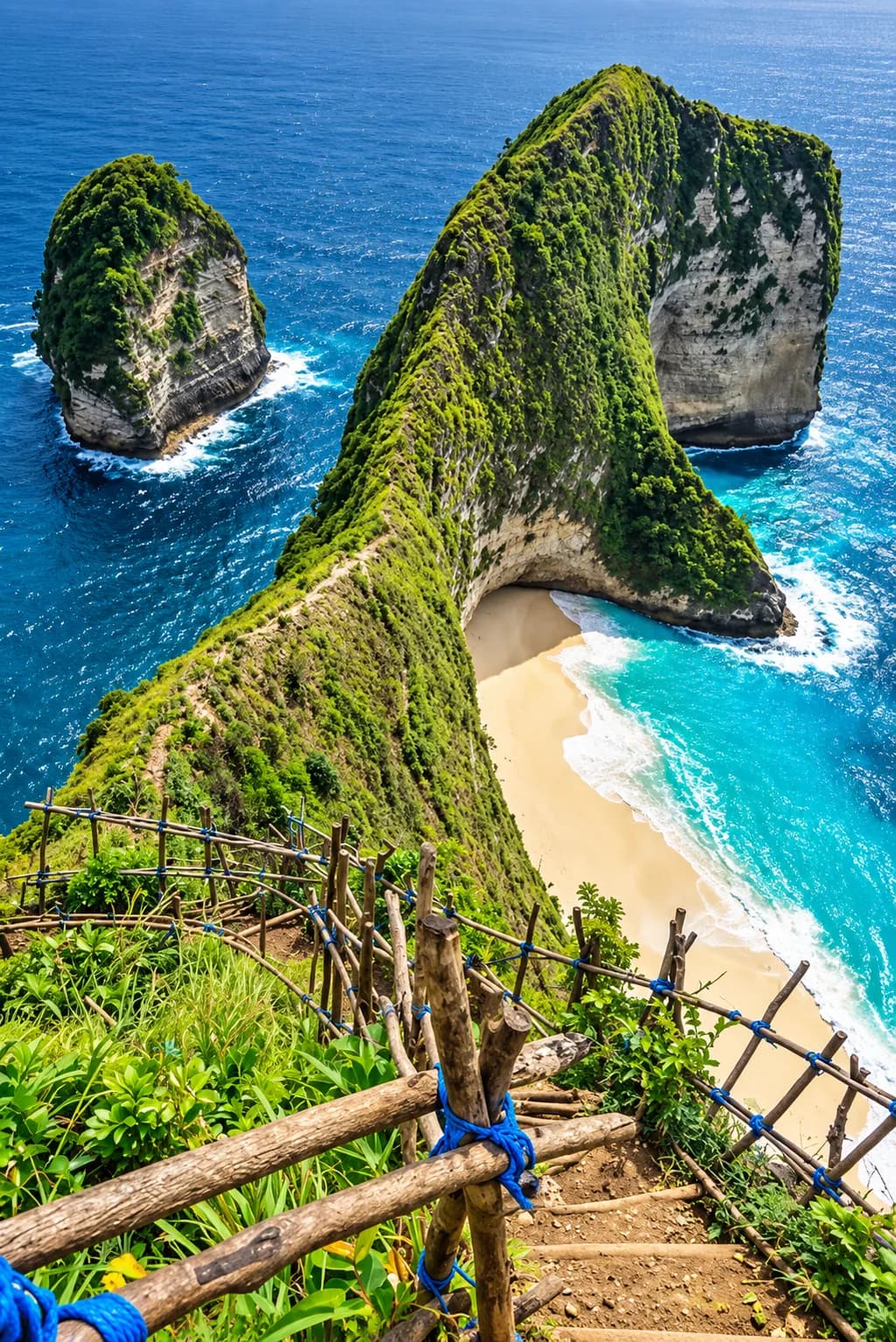
Nusa Penida, reachable by a roughly 30–45 minute speedboat from Sanur or Padang Bai, has become one of Bali's most-photographed add-ons — Kelingking Beach's cliff-and-lagoon view, Angel's Billabong's natural infinity pool, and Broken Beach's collapsed sea arch are the three standout stops. The island's road network is rough in places, so a day trip with a private driver or organised tour is the practical way to cover its spread-out attractions rather than attempting it independently without local transport arranged.
A single long day trip covers the main viewpoints, though sea conditions can affect the boat crossing, particularly outside the dry season — build a buffer day into your itinerary if Nusa Penida matters enough to you that you'd rather not lose it to a cancelled crossing. The Gili Islands (technically closer to Lombok than Bali) are a separate, car-free island cluster some travellers add on for diving and a slower pace, usually requiring at least one extra night given the additional boat transfer involved.
Things to Do in Bali
Beyond the named attractions, Bali rewards a few activity-based approaches depending on where you're based: surfing or a surf lesson at Kuta or Canggu, a sunrise trek up Mount Batur (typically a pre-dawn start with a guide), a half-day cooking class or yoga session in Ubud, waterfall visits around Tegenungan or further north near Munduk, and at least one beach-club afternoon in Seminyak or Canggu if that's your style. Photography-focused travellers should prioritise Tegalalang's rice terraces in the morning light, Uluwatu or Tanah Lot at sunset, and Nusa Penida's Kelingking viewpoint.
Bali Nightlife
Bali's nightlife is concentrated in Seminyak, Kuta and Canggu, ranging from beach clubs with daytime-to-evening crowds to late-night clubs in Kuta's more built-up stretch. Seminyak and Canggu lean toward a more curated, upmarket beach-club scene; Kuta's nightlife is denser and more backpacker-oriented. Ubud, by contrast, is a genuinely quiet town after dark, built around early nights and wellness routines rather than nightlife — worth knowing if an active evening scene matters to your choice of base.
Standard precautions apply: use licensed taxis or ride-hailing apps rather than unmarked transport late at night, keep an eye on drinks in busy clubs as you would anywhere, and be aware that Indonesia has strict laws around drugs, with serious, non-negotiable penalties — this isn't an area to take any risk with.
Balinese and Indonesian Food in Bali
Balinese and broader Indonesian cuisine both feature on most menus, built around rice, fresh spices, and a strong satay and grilled-meat tradition, alongside a genuinely good vegetarian and vegan scene, particularly in Ubud.
| Dish | What It Is |
|---|
| Nasi Goreng | Indonesia's signature fried rice, often with egg, chicken or prawns |
| Mie Goreng | Fried noodles, the noodle counterpart to nasi goreng |
| Satay (Sate) | Grilled meat skewers served with peanut sauce |
| Babi Guling | Balinese roast suckling pig — not vegetarian, a Balinese specialty worth knowing about either way |
| Gado-Gado | Mixed vegetable salad with peanut sauce — genuinely vegetarian |
| Nasi Campur | Steamed rice with a selection of small side dishes, vegetarian versions widely available |
| Lawar | Mixed vegetables and shredded coconut, traditionally with minced meat, with vegetarian versions available in tourist areas |
| Tempeh and tofu dishes (tempe, tahu) | Fermented soy and tofu preparations, a genuine vegetarian staple across Indonesia |
Vegetarian and vegan travellers are generally well served in Bali's tourist areas, especially Ubud, which has built a strong reputation for vegetarian and vegan cafes independent of its temple and rice-terrace draw. Tempeh and tofu dishes are a genuine, widely available part of Indonesian cuisine rather than a tourist accommodation, which makes vegetarian eating here easier than in many short-haul destinations. That said, always confirm preparation specifics (shared grills, fish-sauce-based condiments) if you keep a strict vegetarian diet.
Bali for Indian Travellers
A few practical points for planning this trip from India: Bali's Hindu-majority culture — temple ceremonies, daily offerings, festivals — gives the island a degree of cultural familiarity that's unusual for a Southeast Asian beach destination, even though Balinese Hinduism has its own distinct traditions rather than mirroring Indian practice. Indian restaurants are available in Bali's main tourist areas (Seminyak, Kuta, Ubud), and vegetarian options are genuinely good throughout, as covered above.
English is commonly spoken in tourist areas, hotels and restaurants, though Indonesian (Bahasa Indonesia) is the official language and Balinese is widely spoken locally. Card payments are accepted at most hotels, restaurants and larger shops, though cash (Indonesian Rupiah) remains useful for smaller warungs, markets and Nusa Penida's more rural stretches. Connectivity is generally reliable in South Bali and Ubud, with patchier mobile coverage on Nusa Penida and in more remote parts of the north. For families, South Bali's resort infrastructure (Nusa Dua and Seminyak in particular) is well set up for children; for groups, Bali's range of villa rentals makes it easy to book one large private property rather than splitting a group across hotel rooms.
Indonesia Visa for Indians (Bali Visa on Arrival / e-VOA)
Indian passport holders need a visa to enter Indonesia, and Bali-bound travellers typically use the Visa on Arrival (VOA) or its online equivalent, the electronic Visa on Arrival (e-VOA). This is a straightforward, widely used process — not the stricter advance-visa route required for some other visa categories.
Based on currently published guidance, the VOA/e-VOA is issued as a short-stay tourist entry, valid for 30 days from arrival, with a one-time extension of a further 30 days available after arrival (processed through local immigration offices in Bali, not before travel). The standard fee is commonly reported at around IDR 500,000 (roughly ₹2,500–2,800, though this fluctuates with the exchange rate). Travellers to Bali specifically should also know about a separate Bali Tourism Levy — reported at around IDR 150,000 — which is a tourism/environmental fee distinct from the visa fee itself, introduced to fund conservation and cultural preservation on the island.
The e-VOA can be applied for online in advance (commonly recommended 7–14 days before travel) through evisa.imigrasi.go.id, Indonesia's official immigration e-visa portal — this is the only source to treat as authoritative for current fees, validity and documentation requirements. Alternatively, the VOA can be obtained directly on arrival at Ngurah Rai International Airport. Typical documentation includes a passport valid for at least six months beyond your travel dates, a return or onward ticket, and proof of accommodation.
Visa fees, the tourism levy amount, and processing details change periodically, and this article isn't a substitute for checking evisa.imigrasi.go.id directly before you travel. If you'd rather not manage the application yourself, our team can walk you through the current process when you enquire about your Bali trip.
How to Reach Bali from India
Direct flights connect several Indian cities to Bali's Ngurah Rai International Airport (Denpasar), reducing the trip to a single long-haul-adjacent flight rather than a multi-leg journey through a Southeast Asian hub.
| Departure City | Route Type | Approx. Flight Time |
|---|
| Delhi | Direct | ~8–9 hours |
| Mumbai | Direct | ~8–9 hours |
| Bangalore | Direct | ~6–7 hours |
| Chennai | Direct | ~6–7 hours |
| Hyderabad | Connecting, typically via Delhi, Mumbai or a Southeast Asian hub | 9+ hours with layover |
Airlines add, change and suspend routes regularly, and return-leg routing doesn't always mirror the outbound route exactly, so treat this as a general picture rather than a booking guarantee — confirm current direct-flight availability and schedules in both directions when you're ready to book.
Bali Airport
Flights land at Ngurah Rai International Airport (DPS), in Bali's south near Kuta, making it a short drive to most South Bali hotels and a roughly 1–1.5 hour drive to Ubud depending on traffic. Licensed airport taxis and pre-booked hotel transfers are the standard way to reach your accommodation; ride-hailing apps operate on the island but face some pickup restrictions directly at the airport terminal, so a pre-arranged transfer is usually the smoother option after an international flight.
Getting Around Bali
| Option | Best For | Notes |
|---|
| Private driver (full or half day) | Sightseeing, day trips, multi-stop itineraries | The most common way visitors get around; hired by the day rather than per ride |
| Ride-hailing apps | Short point-to-point trips in South Bali and Ubud | Some pickup restrictions in certain tourist zones and at the airport |
| Scooter rental | Short distances, confident riders | Requires genuine riding experience and an international driving permit; traffic can be heavy |
| Taxi | Airport transfers, short city trips | Use licensed, metered taxis |
| Boat transfer | Nusa Penida, Gili Islands | Needed for any offshore-island add-on |
Bali doesn't have a comprehensive public transport network geared toward tourists, so a private driver hired for the day (common and relatively affordable) or pre-arranged transfers are how most visitors cover multi-stop days, especially when combining Ubud, South Bali beaches and day trips in one itinerary.
Bali Itineraries: 3 to 7 Days
3 Days / 2 Nights
Day 1: Arrive, check in to a South Bali base (Seminyak or Canggu), evening at the beach. Day 2: Uluwatu Temple and Kecak dance at sunset, beach club afternoon. Day 3: Tanah Lot on the way to the airport, or a half-day Ubud trip if timing allows, departure.
4 Days / 3 Nights
Day 1: Arrive, South Bali. Day 2: Full day in Ubud — Tegalalang Rice Terrace, Monkey Forest, Tirta Empul. Day 3: Uluwatu Temple and sunset Kecak dance. Day 4: Beach morning, departure.
5 Days / 4 Nights
Day 1: Arrive, South Bali. Day 2: Ubud day trip — rice terrace, Monkey Forest, Tirta Empul. Day 3: Nusa Penida full-day boat trip. Day 4: Uluwatu Temple, beach club evening. Day 5: Free morning, departure.
6 Days / 5 Nights
Day 1: Arrive, South Bali. Day 2–3: Ubud stay — rice terraces, Monkey Forest, Tirta Empul, a cooking class or yoga session. Day 4: Transfer back to South Bali, Uluwatu Temple at sunset. Day 5: Nusa Penida full-day trip. Day 6: Beach morning, departure.
7 Days / 6 Nights
Day 1: Arrive, South Bali. Day 2–3: Ubud — rice terraces, Monkey Forest, Tirta Empul, Besakih half-day. Day 4: Transfer to Uluwatu or Seminyak. Day 5: Nusa Penida full-day trip. Day 6: Beach day, optional Tanah Lot sunset. Day 7: Departure.
Splitting the stay between Ubud and a South Bali beach town, rather than basing in one place for the whole trip, is how most well-planned Bali itineraries of 5+ days are structured — it avoids long daily round trips between the two very different sides of the island.
Planning a Bali Trip?
Tell our travel team your preferred travel dates, number of travellers, hotel preference and approximate budget, and we'll help you plan a suitable itinerary and share current hotel and route options. Call or WhatsApp us at +91 95990 67086 — or get in touch through our enquiry form and our team will get back to you.
Bali Trip Cost
| Cost Category | Budget Traveller | Comfortable Traveller | Premium/Luxury Traveller |
|---|
| Flights (round trip) | Economy, advance booking | Economy, flexible dates | Premium economy or business |
| Visa | VOA/e-VOA standard fee | VOA/e-VOA standard fee | VOA/e-VOA standard fee |
| Accommodation | Budget guesthouses, hostels | 3–4 star hotels, mid-range villas | 5 star resorts, private pool villas |
| Local transport | Scooter rental, occasional driver | Private driver for day trips | Private driver throughout |
| Meals | Local warungs | Mix of local and tourist-oriented restaurants | Fine dining, resort dining |
| Sightseeing & day trips | Self-arranged, group tours | Organised half/full-day tours | Private guided tours |
| Activities | Minimal | Cooking class, yoga session, one day trip | Multiple curated experiences, spa treatments |
Actual totals depend heavily on season, hotel category and how far ahead you book flights, and INR-to-rupiah exchange rates shift over time, so we won't quote a single "this is what Bali costs" figure. As a general pattern, Bali is genuinely one of the more affordable popular international destinations for Indian travellers once flights are booked in advance, with accommodation in particular offering strong value across budget and mid-range categories compared to equivalent quality in Western destinations.
Get Your Customized Bali Quote
Once you have a rough sense of your dates and budget, our team can share current hotel options and a realistic cost breakdown for your specific trip. Call or WhatsApp +91 95990 67086 — share your travel dates, number of travellers and preferred budget, and we'll take it from there.
Bali Tour Packages from India
Travel packages for Bali can be customised based on your preferred dates, hotel category, number of travellers, inclusions and experiences — rather than a single fixed itinerary that may not match what you're actually looking for. A customised Bali package can include flights, hotel or villa accommodation, airport transfers, sightseeing (Ubud, temples, Nusa Penida day trips), local transportation, activities like a cooking class or yoga session, meals where relevant, visa guidance, travel insurance, and a day-by-day itinerary built around your dates and pace.
At Shubh Mangal Yatra, we arrange Bali trips through our travel network based on what you need rather than a fixed template — see our Bali trip page to request a current quotation based on your travel dates, group size and preferences. See our international tour packages for the broader range of destinations we help plan, or our honeymoon and luxury collections if either fits your Bali trip style.
Bali Hotels and Where to Stay
| Area | Best For | Trade-off |
|---|
| Ubud | Rice-terrace views, wellness retreats, cultural immersion | Furthest from the beach, quieter nightlife |
| Seminyak | Upmarket beach clubs, shopping, dining | Busier and pricier than Kuta or Canggu |
| Canggu | Surf culture, cafes, a younger crowd | Can feel less polished than Seminyak at the budget end |
| Kuta | Budget-friendly, beginner surf, dense tourist infrastructure | Busiest and most built-up stretch of coastline |
| Uluwatu | Clifftop scenery, quieter upmarket resorts | Further from restaurants and nightlife, more reliant on transport |
| Nusa Dua | Resort-focused, family-friendly, calmer beaches | Less local character, more of a resort-enclave feel |
Splitting a stay between Ubud and a South Bali beach area is the standard way to get both sides of the island without over-committing to one base; Nusa Dua suits families prioritising resort convenience, while Uluwatu and Canggu suit travellers who want scenery or surf culture over central nightlife. We don't publish specific hotel or villa names here since availability and quality shift season to season — our team shares current, vetted options matched to your dates and budget when you enquire.
Bali for Every Kind of Traveller
Couples and honeymoon
Bali's mix of clifftop sunset temples, beach-club evenings and private pool villas (widely available even at mid-range prices) makes it one of the more established honeymoon destinations for Indian travellers. Uluwatu and Seminyak's higher-end resorts suit this best, and a private villa with its own pool is a realistic upgrade here in a way it often isn't in pricier destinations.
Families
Nusa Dua and parts of Seminyak have resort infrastructure genuinely built around families — kids' clubs, calmer beaches, villa accommodation that suits multi-generational groups. Ubud's rice terraces and the Monkey Forest work well as family activities too, though pack realistic expectations around heat and walking distances with younger children.
Luxury travellers
Private pool villas, a private driver for the full trip, curated day trips to Nusa Penida or Ubud with a private guide, and fine dining across Seminyak and Ubud are where a Bali trip scales up meaningfully — and Bali's villa market in particular offers a genuinely strong luxury-for-value proposition compared to similarly priced hotels elsewhere. We build these as fully private itineraries on request.
Groups
Bali's villa rental market makes group trips genuinely practical — a single large private villa with a pool often works out better for a group of 6–10 than splitting across hotel rooms, and private drivers can be arranged for the whole group's sightseeing days rather than coordinating separate transport.
What to Pack for Bali
Pack light, breathable clothing for the heat and humidity year-round, plus a light rain layer if travelling in the wet season (November–March). A sarong is worth carrying for temple visits — most temples have rental sarongs available, but having your own saves time and a small fee. Reef-safe sunscreen, insect repellent, and comfortable sandals or walking shoes cover most sightseeing days. Carry a printed copy of your e-VOA confirmation (or be ready to pay the VOA fee in cash or card on arrival), a universal power adapter (Indonesia uses European-style Type C and F plugs), and any personal medication, since finding specific Indian brands locally isn't guaranteed outside major pharmacies.
Currency in Bali
The local currency is the Indonesian Rupiah (IDR), a high-denomination currency where everyday prices run into the tens and hundreds of thousands — it takes a day or two to stop mentally converting every price. ATMs and currency exchange counters are widely available in South Bali and Ubud; card payments are accepted at most hotels, restaurants and larger shops, though cash remains useful for warungs, markets, temple entry fees and Nusa Penida's more rural stretches. INR isn't directly exchangeable in most places — convert to USD before travel or withdraw rupiah locally via ATM, and check the current exchange rate rather than assuming a fixed INR-to-rupiah rate, since this fluctuates.
Language in Bali
Indonesian (Bahasa Indonesia) is the official language, and Balinese is widely spoken locally alongside it, particularly in villages and among older generations. English is commonly spoken in hotels, restaurants and tourist-facing businesses across Ubud and South Bali, though it thins out in more rural areas and on Nusa Penida. A translation app covers most gaps outside the main tourist zones.
Is Bali Safe?
Bali is generally considered a safe destination for tourists, with low rates of violent crime in the areas visitors typically spend time in. Standard precautions apply: use licensed taxis or ride-hailing apps, keep valuables secure in crowded tourist areas and on beaches, and take scooter safety seriously if you choose to rent one — traffic accidents involving tourist scooter riders are a genuine, well-documented risk, and a valid international driving permit plus a helmet are not optional extras. Indonesia's drug laws are strict and carry severe penalties, including for small quantities. As with any international destination, check current government travel advisories closer to your travel dates.
Bali Travel Tips
| # | Tip |
|---|
| 1 | Apply for your e-VOA at evisa.imigrasi.go.id 7–14 days before travel, or budget time for the on-arrival process |
| 2 | Carry cash for the Bali Tourism Levy and smaller vendors, alongside a card for hotels and larger restaurants |
| 3 | Hire a private driver by the day for multi-stop sightseeing rather than piecing together individual rides |
| 4 | Only rent a scooter if you have genuine riding experience and a valid international driving permit |
| 5 | Carry or rent a sarong for temple visits — most temples require one |
| 6 | Visit Tegalalang Rice Terrace early morning to avoid both heat and tour-group crowds |
| 7 | Book Uluwatu Temple's Kecak dance timing around sunset specifically — that's the point of the visit |
| 8 | Split your stay between Ubud and a South Bali beach town rather than basing in just one |
| 9 | Build a buffer day around any Nusa Penida trip in case of rough sea conditions |
| 10 | Use reef-safe sunscreen, especially before any snorkelling or diving day |
| 11 | Carry a universal power adapter — Indonesia uses European-style plugs |
| 12 | Try gado-gado and tempeh-based dishes if you're vegetarian — they're genuine local staples, not tourist substitutes |
| 13 | Keep a translation app handy outside South Bali and Ubud's main tourist zones |
| 14 | Dress modestly and follow sarong/sash requirements at all active temples |
| 15 | Respect the custom of menstruating women not entering inner temple areas |
| 16 | Avoid any involvement with drugs — Indonesia's penalties are severe and strictly enforced |
| 17 | Confirm your airline's current direct-flight schedule in both directions when booking |
| 18 | Keep both cash and a card on hand — card acceptance thins out at warungs and local markets |
| 19 | Book a villa with a private pool if travelling as a couple or small group — it's a realistic upgrade at Bali's price points |
| 20 | Avoid flip-flops for rice-terrace walks and waterfall visits — paths can be uneven and slippery |
| 21 | Check current entry fees at individual temples and attractions, since these can change |
| 22 | Allow at least 1–1.5 hours for the Ubud-to-South-Bali transfer when planning your day |
| 23 | Carry personal medication from home; specific Indian brands aren't guaranteed locally |
| 24 | Stay hydrated and pace outdoor sightseeing around the midday heat, especially at temples with little shade |
| 25 | Check current travel advisories closer to your travel dates, as with any international trip |
Frequently Asked Questions
Is Bali worth visiting? Yes — for travellers who want a single destination that combines beaches, rice-terrace and temple culture, and a genuinely good vegetarian food scene, Bali covers an unusual amount of ground for one island.
Why is Bali famous? For its Hindu temple culture (distinct from the rest of Muslim-majority Indonesia), its rice terraces and Ubud's wellness and arts scene, its surf beaches, and offshore spots like Nusa Penida.
What is the best time to visit Bali? April to October is the dry season and the most reliable for outdoor sightseeing and beaches; November to March is wetter but still warm, with fewer crowds and lower prices.
How many days are enough for Bali? 5–6 days lets you properly split time between Ubud and a South Bali beach base, plus a Nusa Penida day trip; 7+ days adds comfortable room for Besakih or the Gili Islands.
Is Bali expensive? Generally one of the more affordable popular international destinations for Indian travellers once flights are booked, with strong value on accommodation and food across budget and mid-range categories.
How much does a Bali trip cost from India? It depends heavily on season, hotel category and flight booking lead time — contact our team with your dates and group size for a current estimate rather than relying on a fixed figure.
Is Bali safe for Indians? Yes, generally — Bali has low visible crime in tourist areas; the main safety considerations are scooter traffic and strict drug laws rather than crime against tourists.
Do Indians need a visa for Bali? Yes — Indian passport holders need a Visa on Arrival (VOA) or electronic VOA (e-VOA) to enter Indonesia.
Is Bali visa-free for Indians? No — a visa is required, though the VOA/e-VOA process is straightforward and doesn't need an embassy visit.
What is the Bali e-VOA? An electronic Visa on Arrival applied for online in advance through Indonesia's official portal, evisa.imigrasi.go.id, as an alternative to getting the VOA in person at the airport.
How much does the Bali visa cost? Commonly reported at around IDR 500,000, plus a separate Bali Tourism Levy of around IDR 150,000 — confirm current fees on evisa.imigrasi.go.id before travel, since these can change.
How long is the Bali visa valid? The VOA/e-VOA is typically valid for 30 days from arrival, with a one-time 30-day extension available after you arrive.
What is the Bali Tourism Levy? A separate entry fee for foreign tourists visiting Bali, distinct from the visa fee, introduced to fund environmental and cultural preservation on the island.
What are the best places to visit in Bali? Uluwatu Temple, Tanah Lot, Ubud's rice terraces and Monkey Forest, Tirta Empul, and Nusa Penida's Kelingking Beach cover the core highlights.
What are the best things to do in Bali? A Mount Batur sunrise trek, an Ubud cooking class or yoga session, a Nusa Penida day trip, and watching the Kecak dance at Uluwatu at sunset.
What should I eat in Bali? Nasi goreng, mie goreng, satay, and gado-gado cover the essentials, alongside Bali's own babi guling and lawar specialties for non-vegetarians.
Is vegetarian food available in Bali? Yes, genuinely well — gado-gado, tempeh and tofu dishes, and Ubud's dedicated vegetarian and vegan cafes make Bali easier for vegetarians than many Southeast Asian destinations.
Is Bali good for couples? Yes — clifftop sunset temples, beach-club evenings and widely available private pool villas make it one of the more established romantic destinations for Indian travellers.
Is Bali good for honeymoon? Yes — Uluwatu and Seminyak's resorts and private villas are commonly booked for Bali honeymoons specifically.
Is Bali good for families? Yes — Nusa Dua and parts of Seminyak have resort infrastructure built around families, and Ubud's rice terraces and Monkey Forest work well as family activities.
Can Bali and Nusa Penida be combined? Yes — Nusa Penida is a 30–45 minute speedboat ride from Bali and works well as a full-day trip, with an overnight stay an option if you want a slower pace.
Can Bali and the Gili Islands be combined? Yes, though it typically needs at least one extra night given the additional boat transfer from Bali, since the Gilis sit closer to Lombok than to Bali itself.
Should I stay in Ubud or Seminyak? Ubud suits travellers prioritising rice terraces, wellness and culture; Seminyak and Canggu suit those prioritising beach time, dining and nightlife — many well-planned trips split time between both.
What is the currency of Bali? The Indonesian Rupiah (IDR); cards are widely accepted in tourist areas, with cash useful for warungs, markets and temple fees.
Can Indians use cards in Bali? Yes, at most hotels, restaurants and larger shops, though carrying some rupiah cash is sensible for smaller vendors.
How do I get around Bali? A private driver hired by the day is the most common option for sightseeing; ride-hailing apps work for short trips in South Bali and Ubud, and scooters suit confident, licensed riders only.
How do I reach Bali from Delhi? Direct flights connect Delhi to Bali's Ngurah Rai International Airport, taking roughly 8–9 hours — confirm current schedules when booking.
How do I reach Bali from Mumbai? Direct flights connect Mumbai to Bali, taking roughly 8–9 hours — confirm current schedules when booking.
How do I reach Bali from Bangalore or Chennai? Direct flights are currently available from both cities, with shorter flight times than from Delhi or Mumbai — confirm current routes and schedules when booking.
What is Bali's airport called? Ngurah Rai International Airport (DPS), located in South Bali near Kuta.
Is there a Bali tour package from India? Shubh Mangal Yatra arranges customised Bali trips through our travel network based on your dates, hotel preference, group size and budget — contact our team for a current quotation rather than a fixed listed package.
What should I pack for Bali? Lightweight, breathable clothing, a sarong for temples, reef-safe sunscreen, comfortable walking shoes, a universal power adapter, and your e-VOA confirmation or visa-on-arrival fee in cash or card.
Is Bali part of Indonesia? Yes — Bali is one of Indonesia's islands, in the Lesser Sunda Islands chain, and is culturally distinct from the rest of the country as Indonesia's Hindu-majority island.
Is visiting Bali in the rainy season worth it? Yes, for travellers prioritising lower prices and fewer crowds — expect regular but often short afternoon showers rather than all-day rain, with the island staying warm throughout.
Plan Your Bali Trip with Shubh Mangal Yatra
We help arrange a customised itinerary, hotel and villa options across Ubud, Seminyak, Kuta, Uluwatu and Nusa Dua, airport transfers, sightseeing and day trips, activities and experiences, and family, couple and group trips, including premium and luxury options — built around your dates rather than a fixed template.
Share your travel dates, number of travellers and preferred budget with our team, and we'll share suitable hotel options and a personalised quotation. Visit our Bali trip page to enquire, call or WhatsApp us at +91 95990 67086, or talk to our travel team through our enquiry form.