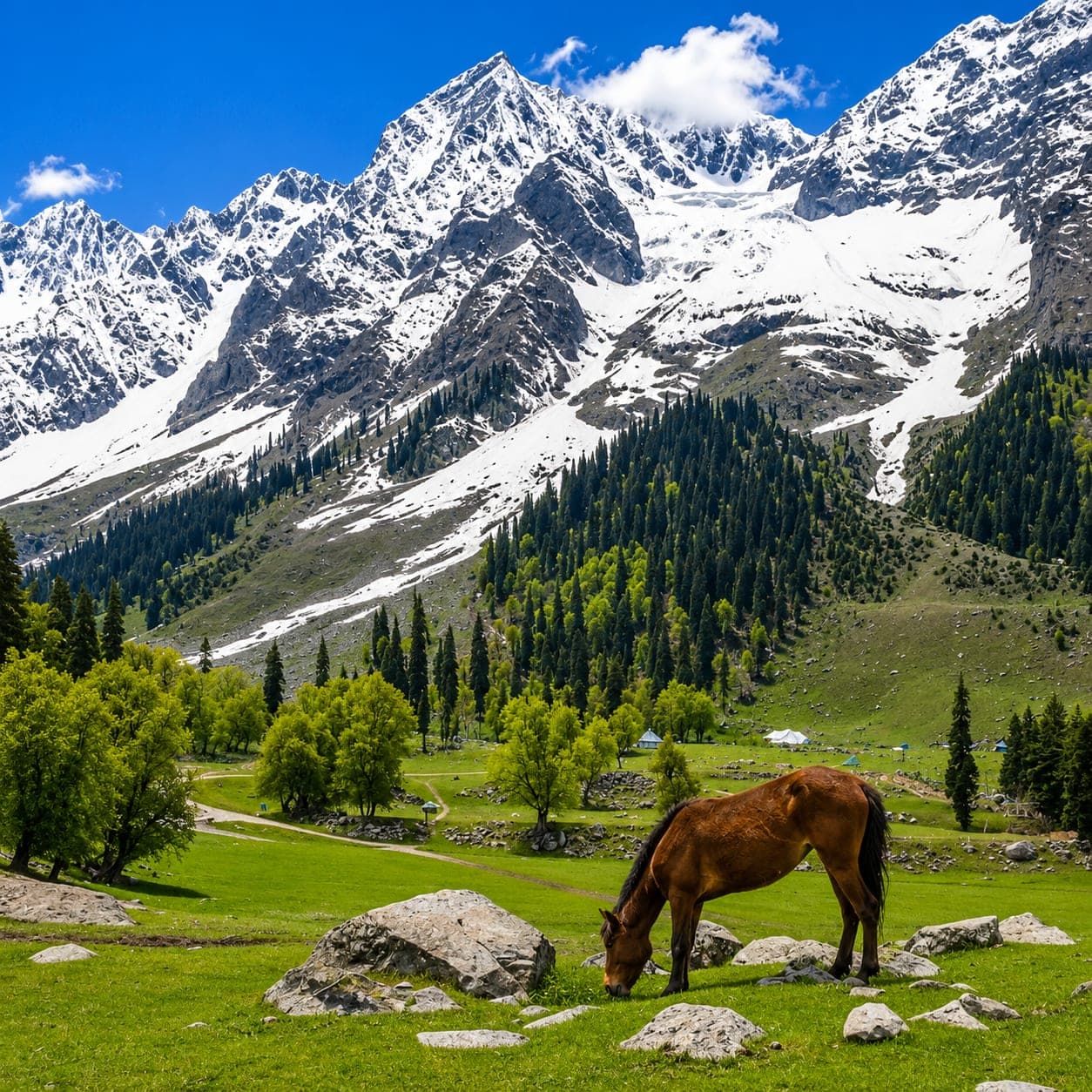
Kashmir doesn't really have a single "best" month — it has several good answers depending on what you actually want from the trip. Someone chasing snow at Gulmarg and someone chasing Srinagar's spring gardens are, in a real sense, planning two different trips that happen to share a destination name.
This guide breaks Kashmir down season by season and month by month, so instead of a generic "April to October" answer, you can match your travel dates to what the valley genuinely offers at that time — weather, crowds, road access, and which parts of the region are actually worth visiting when.
What Is the Best Time to Visit Kashmir?
For most first-time visitors covering Srinagar, Gulmarg, Sonmarg and Pahalgam, April through October is the safest window — gardens are open, roads to all four towns are generally accessible, and the weather suits a full day of sightseeing. Within that stretch, though, spring, summer and autumn each deliver something different, and winter — outside that window — is its own distinct trip, built around snow rather than sightseeing variety.
| Season | Months | What It's Like | Best For |
|---|
| Winter | December–February | Cold, often snow-covered, Gulmarg fully operational for skiing | Snow lovers, honeymooners wanting a quieter Srinagar |
| Spring | March–April | Mild days, blossoms, higher altitudes still thawing | Photography, gardens, fewer crowds than summer |
| Summer | May–June | Warm valley days, all four towns fully accessible | First-time visitors, families, the full circuit |
| Monsoon | July–September | Occasional showers, greener landscapes, fewer crowds | Budget-conscious travellers comfortable with some rain |
| Autumn | October–November | Cool, clear days, chinar colour in Srinagar | Photography, quieter sightseeing, easing prices |
There's no wrong season here — only a mismatch between what a season offers and what you came for. The sections below go into each one in more depth.
Kashmir in Winter (December–February)
Winter turns Kashmir into a genuinely different destination. Srinagar gets cold — often near or below freezing overnight — and Dal Lake can partially ice over at its edges in the coldest years, but the city itself stays atmospheric rather than shut down. Gulmarg is the season's real draw: this is when its slopes are open for skiing and snowboarding, and the Gondola ride shifts from meadow views to a proper snow-covered mountain experience.
Road access to Sonmarg and parts of Pahalgam can be affected by heavy snowfall, so winter itineraries are usually built around Srinagar and Gulmarg rather than the full four-town circuit. December through mid-February — the stretch locally known as Chillai Kalan — is the coldest and often snowiest part of winter; our guide to Chillai Kalan covers that window in more detail if serious snow is your priority.
Kashmir in Spring (March–April)
Spring is Kashmir's quieter, shorter spectacle. Srinagar's almond orchards — Badamwari in particular — bloom in the second half of March, usually for a couple of weeks, and by April the Mughal gardens are properly green with early blossom colour. Daytime weather is mild and pleasant, though higher-altitude spots like Sonmarg can still be thawing out from winter snow early in the season, which sometimes limits access in March.
Crowds are noticeably thinner than summer, hotel and houseboat rates tend to be gentler, and the light is good for photography. If blossom season specifically is what's drawing you, timing matters more here than in any other season — see our guide to Srinagar's almond blossom season for exact windows.
Kashmir in Summer (May–June)
May and June are Kashmir's most reliably accessible months, and the busiest. Gulmarg's meadows are fully green, Sonmarg's Thajiwas Glacier is easily reachable, and Pahalgam's Aru and Betaab valleys are at their most walkable. This is when the complete Srinagar–Gulmarg–Sonmarg–Pahalgam circuit runs most smoothly, with every stop fully open and roads clear.
It's also peak season, which means the busiest hotels, houseboats and viewpoints of the year, along with the highest prices. For a first Kashmir trip where you want to see everything without worrying about weather or road closures, summer is the least risky choice — you're trading quiet for reliability.
Kashmir in Monsoon (July–September)
Kashmir doesn't get monsoon rain the way much of India does — the valley sits largely in a rain shadow, so July to September brings occasional showers rather than sustained downpours. Landscapes stay green and lush through this period, and it's a genuinely underused window: crowds thin out from the June peak, and rates ease slightly at hotels and houseboats.
The trade-off is a somewhat higher chance of a rained-out sightseeing day here and there, and September specifically starts transitioning toward autumn's cooler, clearer weather. If your dates are flexible, early September often gives you monsoon-season pricing with autumn-adjacent weather.
Kashmir in Autumn (October–November)
Autumn is arguably Kashmir's most underrated season. Srinagar's chinar-lined avenues — especially around Naseem Bagh and the Mughal gardens — turn deep red and gold through October, daytime weather stays comfortable, and the summer crowds are long gone. Pahalgam's valleys hold onto their greenery a little longer, and Gulmarg gets progressively quieter as it waits for winter snow.
By November, Sonmarg starts closing down for the season and mornings turn properly cold across the valley, so plan an autumn Sonmarg visit for October at the latest. Our dedicated autumn Kashmir guide covers this season's chinar colour and photography opportunities in full.
Best Time to Visit Kashmir by Month
Here's how each month actually breaks down, if you want more precision than a seasonal range gives you.
January Peak winter and often the coldest month. Gulmarg is at its snowiest and best for skiing; Srinagar is atmospheric but cold, and Sonmarg and Pahalgam access can be limited. Best suited to travellers whose main goal is snow.
February Still firmly winter, though slightly milder than January toward month-end. Gulmarg's ski season remains strong — a good alternative to January if you want snow without quite as sharp a cold.
March The shift from winter to spring, with Badamwari's almond blossoms opening in Srinagar by mid-to-late month. Higher areas may still be thawing, so it suits travellers prioritising Srinagar and blossom season over the full circuit.
April Spring in full swing — mild days, blooming gardens, and most of the circuit reopening as snow clears from access roads. A strong, less-crowded alternative to summer for travellers who don't need every valley fully green yet.
May Early summer, with Gulmarg's meadows greening up and warmer, longer days across the valley. Crowds start building toward the June–July peak, but roads and sightseeing are fully accessible.
June Kashmir's most reliable all-round month — every stop on the Srinagar–Gulmarg–Sonmarg–Pahalgam circuit is fully open, weather is warm and settled, and it's the easiest single month to recommend to a first-time visitor. Also among the busiest and priciest.
July Peak summer transitioning into monsoon. Landscapes are lush and green, occasional rain is possible, and crowds remain high through the first half of the month before easing.
August Similar to July — warm and green, with intermittent rain. A reasonable compromise month if you want summer's accessibility with slightly thinner crowds than June.
September A genuinely good transitional month — monsoon showers taper off, crowds drop noticeably from summer levels, and by late September the weather starts resembling autumn's crisper, clearer days.
October Chinar season in Srinagar and arguably the strongest all-round month for photography — comfortable daytime weather, thin crowds, and every part of the circuit still accessible. A favourite among repeat visitors.
November Late autumn tipping into early winter. Sonmarg starts closing for the season, mornings turn cold, and Gulmarg begins its shift toward a winter identity. Good for travellers who want autumn's calm without full winter cold.
December Winter arrives properly, with Chillai Kalan beginning around December 21. Gulmarg's ski season gets underway, Srinagar turns cold and quiet, and outer-valley access becomes more weather-dependent.
Best Time to Visit Srinagar
Srinagar is Kashmir's one truly year-round base — Dal Lake, the houseboats and the Mughal gardens are worth visiting in every season, just for different reasons. Spring and autumn are the strongest all-round picks: spring for blossoms and mild weather, autumn for chinar colour and thin crowds. Summer works well too, especially for travellers combining Srinagar with the rest of the circuit, though it's also the city's busiest stretch. Winter Srinagar is genuinely atmospheric — cold, quieter, occasionally snow-dusted gardens — and suits travellers who want the city experience without summer's crowds. See our Jammu & Kashmir destination guide for more on the wider region.
Best Time to Visit Gulmarg
Gulmarg genuinely rewards two opposite seasons for two opposite reasons. Winter (December–February) is when it functions as a serious ski and snowboard destination, with the Gondola running over snow-covered slopes — this is peak Gulmarg for anyone chasing snow. Summer (May–June) turns the same slopes into rolling green meadows, historically used as a hill retreat, and is the better choice if skiing isn't the point of your trip. Spring and early autumn both work as shoulder-season options with thinner crowds, though the meadows won't be at full summer green.
Best Time to Visit Pahalgam
Pahalgam's real value is as a base for excursions — Baisaran, Betaab and Aru valleys — so its best season tracks closely with the wider valley's spring-through-autumn window. Summer gives the greenest, most walkable landscape across all three side valleys. Autumn holds onto greenery a little longer than you'd expect, trading some of that lushness for thinner crowds and better light. Winter sightseeing in Pahalgam itself is more limited, since several of its side valleys become harder to access once snow sets in.
Best Time to Visit Yusmarg
Yusmarg — a quieter meadow excursion west of Srinagar, less visited than Gulmarg or Pahalgam — follows a similar pattern to other valley meadows: best from April through October, when it's accessible and green, with June through September generally offering the fullest, lushest landscape. Because it's typically visited as a day trip from Srinagar rather than a standalone base, it's worth planning around whichever core season you've already chosen for the rest of your circuit.
Best Time to Visit Kashmir for Different Types of Travellers
Couples and honeymooners Spring and autumn tend to suit honeymooners best — mild weather, thinner crowds, and a Dal Lake houseboat night that feels more private outside peak summer. Winter is a strong alternative for couples who specifically want a snow-and-bonfire kind of trip.
Families Summer (May–June) is the easiest season for families — predictable weather, fully open sightseeing, and no risk of a snow-related itinerary change. Early autumn (September) works well too, with fewer crowds to navigate with children in tow.
First-time visitors June is the safest single recommendation for a first Kashmir trip, since every part of the standard circuit is reliably accessible. If you'd rather avoid peak crowds, April or October are strong alternatives that don't compromise much on accessibility.
Snow lovers December through February, with January typically the snowiest stretch and the strongest for skiing at Gulmarg. This is a fundamentally different trip from the rest of the year, built around Gulmarg rather than the full four-town circuit.
Photography lovers October is hard to beat, with chinar colour in Srinagar and clear autumn light. Late March's almond blossoms and winter's snow-covered Gulmarg are strong specialist alternatives if you're chasing a specific shot rather than general variety.
Nature lovers June through September, when meadows, glaciers and valleys are all at their greenest, gives the fullest sense of Kashmir's landscape variety in a single trip.
Travellers who want a quieter experience September and late March are the two best-kept-secret windows — past or before the main crowds, with weather still good enough for full sightseeing.
When Is Kashmir Most Crowded?
June and July are Kashmir's busiest months by a clear margin, driven largely by Indian school summer holidays and generally reliable weather across the whole circuit. Winter holidays (late December into the new year) create a second, smaller crowd spike specifically around Gulmarg's ski season. If avoiding crowds matters more to you than hitting the single "safest" weather window, April, September and October are your best options — good weather with noticeably thinner tourist traffic than peak summer.
When Is the Cheapest Time to Visit Kashmir?
As a general pattern, hotel and houseboat rates in Srinagar, Gulmarg and Pahalgam rise through peak summer (May–July) and again around winter holidays, and ease off during the shoulder seasons — spring before the summer rush, and the monsoon-to-early-autumn stretch (August–September) after it. We'd avoid quoting exact figures here, since pricing varies by year, group size and stay category — but if budget matters more to you than weather predictability, those shoulder months are generally where you'll find more give in hotel and houseboat rates.
How Many Days Are Enough for Kashmir?
4–5 days Enough for Srinagar plus one or two outer towns — typically Srinagar and Gulmarg, or Srinagar with a Doodhpathri or Yusmarg day trip. You'll get a genuine taste of the valley without the full circuit.
6–7 days The sweet spot for most first-time visitors, covering Srinagar, Gulmarg, Sonmarg and Pahalgam without rushing between towns. Our own Srinagar, Gulmarg, Sonmarg & Pahalgam circuit runs exactly this length — 7 days, 6 nights, including a Dal Lake houseboat night.
8–10 days Worth considering if you want a slower pace through Pahalgam's side valleys, an extra buffer day for weather, or you're combining Kashmir with a wider Jammu & Kashmir circuit. Beyond 10 days, most travellers are better served pairing Kashmir with a separate region like Ladakh rather than stretching a single-valley itinerary further.
If your dates are tighter than any of this, a shorter Srinagar-focused trip is still genuinely worthwhile rather than something to skip.
What Should You Pack for Kashmir?
Packing changes more by season here than in most Indian destinations, so match your bag to your travel window rather than a generic hill-station list. For winter (December–February), serious layers are non-negotiable: thermal base layers, a heavy insulated jacket, waterproof boots and gloves — Delhi-winter clothing genuinely isn't enough for Srinagar, and Gulmarg runs colder still. For spring and autumn (March–April, October–November), a light-to-medium jacket for the day and a proper warm layer for evenings covers most conditions, since mornings and nights turn cold even when afternoons feel mild. For summer (May–June), light layers work for daytime, but keep one warm layer on hand for Gulmarg and Sonmarg, where evenings stay noticeably cooler than the valley floor. For monsoon months (July–September), add a light rain jacket or umbrella alongside your regular layers. Comfortable, broken-in walking shoes matter in every season, given the pony rides, garden walks and uneven paths across most itineraries.
Frequently Asked Questions
What is the best time to visit Jammu and Kashmir overall? April through October covers the full Srinagar–Gulmarg–Sonmarg–Pahalgam circuit reliably; December through February is better if snow at Gulmarg is your specific priority.
What is the best season to visit Kashmir with family? Summer (May–June) or early autumn (September) — both offer predictable weather and full sightseeing access without winter's road-access complications.
Is Kashmir better in summer or winter? Neither is objectively "better" — summer gives you the full four-town circuit and warm weather, while winter delivers a genuine snow experience centred on Gulmarg. The right choice depends on what you're travelling for.
What is the best time to visit Srinagar and Gulmarg together? May through June or September through October both work well for pairing the two — full access to Gulmarg's meadows or early autumn colour, alongside comfortable Srinagar sightseeing.
When should I visit Kashmir to avoid crowds? April, September and October offer good weather with noticeably fewer tourists than the June–July peak.
What is the peak tourist season in Kashmir? June and July, driven by summer holidays, with a smaller second peak around Gulmarg's winter ski season in late December and January.
Is Kashmir safe to visit right now? The vast majority of tourist areas in the Kashmir Valley see regular, incident-free tourist traffic — check current government travel advisories close to your travel dates and follow local guidance, as you would for any destination.
What is the best time to visit Kashmir for snowfall? Late December through February, with January typically the snowiest month and the strongest for skiing and snowboarding at Gulmarg.
Can I visit Kashmir in the rainy season? Yes — Kashmir's monsoon (July–September) brings occasional showers rather than sustained rain, and it's a genuinely underused, greener, less crowded window if you're comfortable with some weather uncertainty.
What is the best time to visit Jammu specifically? Jammu, at a lower altitude than the Kashmir Valley, is more comfortable outside peak summer — October through March suits sightseeing and pilgrimage travel better, since Jammu's summers run considerably hotter than Srinagar's.
How far in advance should I book for peak season? For June, July and the winter holiday stretch, booking hotels and houseboats several weeks ahead is worth it, since Kashmir's most-requested season also has its most limited houseboat and hotel capacity.
Whichever season fits your dates, the difference in what Kashmir actually offers is real enough to plan around, rather than defaulting to "whenever I'm free." If you'd like help matching your dates to the right itinerary, our Kashmir tour packages cover both the full 7-day circuit and shorter options, or you can plan the wider trip — flights, dates and logistics — with a Delhi-based travel agency that handles Kashmir regularly. For the fuller picture beyond timing, our complete Kashmir travel guide covers geography, food, budgeting and a full sample itinerary.